Practical guide
Biceps Curls with Light Weights: NHS Seated or Standing Steps
Follow the NHS light-weight curl, including its sitting option. Keep the complete bend-and-lower movement and 3 sets of 5 with each arm separate from combined counts or an invented bottle weight.
Check the version before choosing a load
The NHS biceps-curl entry uses a pair of light weights and says filled water bottles will do. In the standing version, start with feet hip-width apart. Keep the arms by your sides, bend until the weight in your hand reaches your shoulder, then lower slowly. The entry also says this can be carried out sitting down.
“Light” is the source’s description, not a measured load selected for you. It gives no required bottle volume, kilogram value or rule that every reader should use identical objects. If the load or movement is unclear or unsuitable, obtain guidance addressing your situation rather than infer a personal target from a household item.
This guide explains the named NHS public exercise entries. Wear comfortable loose clothing, keep water handy and build up gradually. Choose activity and intensity appropriate to your fitness. NHS adult guidance advises speaking to a GP first if you have not exercised for some time or have medical conditions or concerns. Individual instructions take priority; an unstable setup or unsuitable movement is a reason to resolve the difficulty rather than complete a webpage’s count.
This guide focuses on the arm sequence, seated-versus-standing wording and per-arm groups. It is not an equipment review or a progression plan.
Keep the upper arms by your sides and lower slowly
- Use the pair of light weights described by the source, with a setup suitable to you.
- For its standing version, place feet hip-width apart.
- Keep your arms by your sides as you slowly bend them.
- Bring the weight in the hand towards the shoulder, as the entry describes.
- Slowly lower again to complete the movement.
- Retain the source’s three groups of five curls with each arm.
The sitting option does not turn the curl into a new exercise count. It changes the body setup while retaining the named arm movement. The source does not provide a detailed seating specification for this particular curl, an alternating-arm requirement or a speed contest.
Do not add a swing, a required timed hold or a fixed breath count and attribute it to the selected entry. If you need detailed demonstration or support, use appropriate instruction rather than an invented universal rule.
Read 3 sets of 5 with each arm as a per-arm instruction
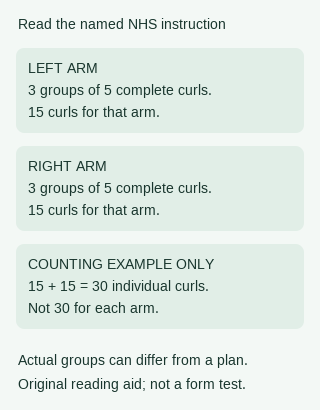
The general NHS strength explanation defines a repetition as one complete movement and a set as a group of repetitions. The named curl entry says to attempt 3 sets of 5 curls with each arm. Keep that specific wording separate from broader general 8–12-repetition strength advice.
Swipe within the table on a narrow screen, or focus it and use the right-arrow key.
| Arm | Source-example grouping | Arithmetic under that convention |
|---|---|---|
| Left | 3 groups of 5 complete curls. | 5 + 5 + 5 = 15 left-arm curls. |
| Right | 3 groups of 5 complete curls. | 5 + 5 + 5 = 15 right-arm curls. |
| Both together | Retain both per-arm groupings. | 15 + 15 = 30 individual arm curls; not 30 each. |
These totals explain the words; they do not prescribe a personal routine or establish the amount actually completed. Both arms may move together or a record may use another explicit convention. Keep that convention visible rather than use the same bare number for two different quantities.
An actual record can differ from the example grouping
Here is an explicitly fictional record: the left arm has groups 5, 4 and 3; the right arm has 5, 5 and 4. The left total is 12 and the right total 14, or 26 individual arm curls under the stated convention. Keep the six rows rather than replace them with the planned 30.
The example demonstrates recording, not whether those amounts or the equipment are appropriate. It does not show that a weaker side needs extra work, explain why the groups differed or instruct a catch-up session.
A count also does not establish load. The public source supplies no bottle specification from which to calculate a verified kilogram-repetition total. Use the quantity and actual-set guide if that is your separate question.
Three checks about sitting, load and per-arm counts
Try these fictional reading questions before opening their answers.
Case 1
Does 3 sets of 5 with each arm mean 15 curls across both arms altogether?
Show answer and explanation for case 1
No. Under the stated individual-arm convention, it is 15 for each arm.
That is 30 individual arm curls across both sides. Preserve the per-arm groups; do not label the same number as bilateral pairs without defining the convention.
Case 2
Does “filled water bottles will do” prove that the NHS requires two 1-litre bottles?
Show answer and explanation for case 2
No. The selected entry gives no bottle volume or kilogram specification.
A household-object example is not a measured personal load recommendation. Resolve suitable equipment rather than invent a size.
Case 3
Must I stand because the entry first mentions feet hip-width apart?
Show answer and explanation for case 3
The source explicitly permits sitting for this curl.
Use an appropriate actual setup and keep the arm sequence. The page does not certify a particular seat or an individual movement’s suitability.
Choose the next specific movement or planning question
For a different upper-body movement, use the wall press-up guide. For standing chair support with a two-heel movement, use supported calf raises. These entries use different setups and source counts; their totals are not interchangeable workout scores.
The beginner planning page helps arrange an appropriate, understandable session. This curl explanation does not decide an individual load, diagnose pain, promise muscle change or calculate weight loss.
Sources and further reading
- NHS: Strength exercisesComplete selected public chair setup, calf-raise and light-weight biceps-curl entries and their actual count wording. Last reviewed 28 February 2024; consulted 8 November 2026.
- NHS: How to improve your strength and flexibilityRepetition and set definitions/general adult strength context; its broader 8–12 guidance is not substituted for the named gentle entries. Reviewed 21 July 2026; consulted 8 November 2026.
- NHS: Physical activity guidelines for adults aged 19 to 64Fitness-appropriate activity and speaking to a GP first after a period without exercise or with medical conditions/concerns. Age-specific context; not a personal rehabilitation plan. Reviewed 22 May 2024; consulted 8 November 2026.