1,417 kcal/day
The equation before activity is added.Adult weight management, bounded
Lose weight with estimates you can question.
Start with TDEE, calorie deficit, and protein estimates, then use source-backed guides to choose one calm next step.
Use calculator
TDEE Calculator
Estimates are for adults and do not replace professional medical advice. Use the result as a planning conversation, then adjust slowly with real trend data.
Estimated TDEE1,948 kcal/dayPlanning estimate
Resting energy1,417 kcal/dayMifflin-St Jeor BMR
Activity multiplier1.375xSelected activity level
7-day action summary
Print-ready plan card
Carry one result, one test, and one review boundary into the week.
Result to carry
Daily energy estimate 1,948 kcal/day from Mifflin-St Jeor plus the selected activity multiplier.
Week-one test
Save the activity label, compare it with your real week, then choose one follow-up: maintenance context, mild deficit, or protein planning.
Review boundary
Choose a deficit rangeMove from maintenance estimate to a conservative target range.Use two to four weeks of routine and trend notes before deciding the estimate is too high or too low.
Assumptions
What This Result Assumes
Keep these assumptions with the number so the result does not turn into false precision.
Formula path
Mifflin-St Jeor BMR multiplied by the selected activity level to create a starting TDEE estimate.
Your selected inputs
US units, female equation, age 35, light activity.
Result boundary
The estimate can drift when activity is misclassified, recent intake changed, sleep or stress shifted, or scale trend data is still too noisy.
Compare
Three Ways to Read the Number
Pick the interpretation that matches the week, not the most aggressive target.
1,948 kcal/day
The main estimate when the activity label matches real life.2-4 weeks
Use trend data before treating the estimate as too high or too low.Calculator chain
TDEE - Deficit - Protein Loop
Use the tools in sequence when the next decision needs a number, then a target, then meal structure.
1TDEE estimate1,948 kcal/day
You are here: keep the activity label beside this estimate before choosing a target.
2Deficit range1,700-1,450 kcal/dayUse this next when the maintenance estimate needs a conservative calorie target.
3Protein range87-115 g/dayUse this when fullness, meal anchors, or protein distribution is the next bottleneck.
Result review card
Save, Print, or Revisit With Context
Copying the result is useful only when the assumptions travel with it.
Save this line
TDEE planning card: 1,948 kcal/day from Mifflin-St Jeor plus the selected activity multiplier, saved with the activity assumption and review window.
Do not infer
This estimate does not measure metabolism, guarantee maintenance calories, or prove that the activity label is correct.
Review when
After two to four weeks, compare the 1,948 kcal/day estimate with routine, appetite, training, sleep, and weight trend notes.
Read the Result by State
The estimate is low confidence when the activity label is a guess, the week was unusual, or input data is approximate.
Save the assumption beside the number before using it for a target.The 1,948 kcal/day estimate is more useful when the selected activity label matches an ordinary week.
Use it as a starting range, then compare it with trend data.A very active label, medical context, recent diet history, or pressure to lose quickly can make the estimate easy to misuse.
Slow the decision down before turning the estimate into a strict target.Water shifts, soreness, stress, sleep, medication context, or travel can hide whether the estimate fits real life.
Review multiple weeks before treating the number as wrong.Return visit
Saved Result History
Save a result to build a small local history for this calculator.
Review loop
7-Day Review Worksheet
Write what you will check before recalculating or making the target stricter.
Return plan
Revisit Reminder
Come back after routine data exists, not after one unusual day.
Save a local reminder after saving a result, then review trend notes before recalculating.
7-Day Experiment
Use the result for one ordinary week before changing the target.
- Day 1Save the estimate: 1,948 kcal/day, with the selected activity label.
- Day 2Check whether the activity label matches your real week.
- Day 3Choose one use for the number: maintenance, mild deficit, or protein planning.
- Day 4Track one ordinary day without changing multiple variables.
- Day 5Note hunger, energy, steps, and training context.
- Day 6Plan a flexible meal or movement fallback for the least predictable day.
- Day 7Review whether the estimate clarified the next decision or needs a wider range.
Next: choose a mild deficit, maintenance range, or protein plan after checking whether the activity label fits your real week.
Choose by user path
Start from the problem you actually have.
Each path keeps the next action narrow enough to test in a normal week.
Start with an estimate, keep the assumptions beside it, then decide whether the next move is calories or meal structure.
Open TDEE calculatorTurn the result into one ordinary-week action instead of adding every habit, meal rule, and workout at once.
Read the estimateSlow down before cutting again, buying a program, or using a plan that feels too strict or medically personal.
Review the plateau200indexable education URLs
3low-risk calculators
0high-risk plan pages
Editorial judgment
How to Use This Page Well
Line-edited 2026-06-21
A useful weight-loss site should not make the reader feel as if the whole plan has to be chosen before breakfast. The homepage now needs to act like a triage desk: if someone needs a number, send them to the TDEE, deficit, or protein calculator; if they already have a number, help them decide what it can and cannot mean; if they feel pulled toward a strict plan, slow the decision down. The homepage should make one promise only: FitBasis will help an adult turn a messy first question into one safer next move. That means showing the tools early, explaining that estimates are assumptions, and making the safety path visible before the reader clicks into a stricter article. A reader should leave this page knowing whether to calculate, read, review, or pause for qualified guidance. The page also has to show that the site has an editorial spine: calculators are not the product, better decisions are. If the reader cannot tell which path fits the next ten minutes, the homepage has failed.
When This Page Helps
A reader arrives after searching for a calorie number. They should see the TDEE calculator first, then a route to the calorie deficit calculator only after the activity assumption is visible.
A reader has opened too many articles and cannot choose. The Start Here hub should be the next click because it narrows the first week instead of adding another rule.
Decision Rule
Use the homepage to decide which kind of help is needed now: a calculator for context, a hub for choosing a topic, a guide for one specific action, or the safety path when a claim or personal health context makes self-guided advice too narrow.
Wrong Use
Do not use the homepage as proof that every reader should calculate calories first. Some readers need meal structure, movement, habit recovery, or professional guidance before a number is useful.
Natural Next Links
Start with the TDEE Calculator when the main unknown is daily energy needs, then keep the activity label beside the result.
Move to the Calorie Deficit Calculator only after the estimate is visible and the reader understands it is a range.
Use the Protein Calculator when the reader needs to turn the plan into breakfasts, lunches, dinners, or grocery choices.
Claim and Source Boundaries
Supports people-first organization and clear navigation.
Does not support keyword-stuffed doorway pages.
Supports gradual behavior framing and practical next steps.
Does not individualize a target for one reader.
Supports visible safety questions and qualified-guidance boundaries.
Does not rate any commercial program for the reader.
Supports exposing the equation behind resting energy estimation.
Does not prove a specific calorie outcome.
Supports baseline nutrient reference framing.
Does not replace clinician-set nutrition guidance.
Boundary
The homepage remains general adult education. Symptoms, medication changes, clinician-set diet limits, harmful restriction history, or persistent distress should move the reader toward qualified guidance.
What This Page Helps You Decide
FitBasis helps adults estimate calories and protein without turning estimates into promises. Start with a calculator, read the assumptions, then use the guides to choose one manageable nutrition, movement, or habit change.
Start with the decision, not the diet label
Most readers do not arrive needing a new identity. They arrive with a smaller problem: a number feels confusing, meals are inconsistent, the scale moved strangely, or the week is already crowded. FitBasis starts by asking what decision the reader actually has to make today. If the decision needs a number, use a calculator. If it needs context, open a guide. If it involves symptoms, medication, a history of harmful restriction, or clinician-set diet limits, use the page as a question list for qualified guidance instead of a self-guided rule.
Use calculators as estimates with assumptions attached
The TDEE, calorie deficit, and protein calculators are useful because they make the assumptions visible. A TDEE result depends heavily on the activity label. A deficit range depends on the TDEE estimate and on whether the target can be repeated without excessive hunger or distress. A protein range depends on body weight and should not override medical nutrition guidance. The next step is not to obey the number. The next step is to decide which ordinary-week experiment the number can support.
Use FitBasis in Five Steps
Move from one estimate or guide to one ordinary-week test.
1Pick the starting question
Decide whether the current problem is a number, a meal, a movement routine, a habit cue, a plateau, or a safety claim.
2Use one primary page
Open the calculator or hub that answers that question and ignore the rest of the site until the first action is clear.
3Write the assumption
Record the activity label, calorie range, protein range, source boundary, or real-life constraint that would change the answer.
4Choose the smallest useful action
Make the next step small enough to test in an ordinary week rather than an ideal week.
5Review before escalating
Use hunger, energy, adherence, schedule fit, and trend notes before making the plan stricter.
Trust and method
How FitBasis keeps estimates bounded.
Visible limits make the tools more useful, not less useful.
Editorial policyHow pages use official and primary source families, plain-language editing, and practical next-step checks.Medical boundaryWhat FitBasis does not provide: diagnosis, treatment, dosage, emergency guidance, or personalized medical advice.Calculator data useCalculator inputs and saved notes stay local in the browser unless a future feature clearly asks otherwise.
Choose a Calculator
Each tool shows assumptions first and sends you to a relevant guide.
Calculator
TDEE Calculator for Adults
Estimate daily energy needs with visible assumptions, activity levels, and next-step links. Includes US/metric inputs, result boundaries, and next steps.
CalculatorCalorie Deficit Calculator
Turn a TDEE estimate into conservative calorie ranges without promising results. Includes US/metric inputs, result boundaries, and next steps.
CalculatorProtein Calculator
Estimate baseline and planning protein ranges for adults with clear medical boundaries. Includes US/metric inputs, result boundaries, and next steps.
Topic clusters
Move from a number to the right next problem.
These clusters keep users from bouncing between similar pages when the real next step is narrower.
The reader needs a number, but the number will be risky if the activity assumption disappears.
Start with the TDEE calculatorThe reader has a maintenance estimate and needs a conservative target that can survive a real week.
Choose a deficit rangeThe reader needs grams to become meals, not a macro rule detached from appetite, fiber, cost, or care limits.
Estimate a protein rangeThe reader feels stuck and may cut calories before checking whether the signal is trend, noise, or routine drift.
Review the plateauThe reader needs enough food structure to act, but not a brittle menu that fails at the first restaurant, workday, or grocery gap.
Open meal planningThe reader is seeing a claim, program, app, or rule that sounds urgent, certain, or medically personal.
Check the safety pathBrowse the System
FitBasis is organized by the decision you need to make, not by a diet label.
Calm Weight Loss Basics
Start Here: Calm Weight Loss Basics
A calm entry path for adults who need one first estimate, one first habit, and a way to stop advice overload.
BasicsWeight Loss Basics
Calorie, plateau, tracking, and weight-trend guides for readers who need to interpret numbers before changing the plan.
Weight ManagementNutrition for Weight Management
Meal-structure guides that turn protein, fiber, snacks, restaurants, and labels into choices a normal week can hold.
Planning GuidesMeal Planning Guides
Meal-plan guides built around groceries, prep time, swaps, fullness, and safety notes rather than brittle menus.
TrainingMovement and Training
Walking, strength, steps, cardio, and restart guides that make activity repeatable before it becomes intense.
HabitsMindset and Habits
Stress, sleep, cravings, routines, and recovery guides for readers whose issue is follow-through in real life.
PlateausMaintenance and Plateaus
Maintenance, plateau, regain, vacation, and long-term routine guides for moving from urgency to steadier review.
Program BoundariesSafety and Program Boundaries
Claim-checking and boundary guides for programs, apps, sales pages, calculators, privacy, and clinician questions.
Publishing quality loop
How weak URLs get found after publishing.
Local readiness does not claim rankings. Live search data becomes a repair queue only after a real domain is authorized.
Catch technical blockers and obviously mismatched first-screen answers without rewriting pages for low impressions alone.
Fix crawlability, rendering, metadata mismatches, broken links, and high-trust boundary gaps.Compare query wording with titles, meta descriptions, first-screen answers, and next-step links.
Adjust title, meta, first-screen answer, or internal links when intent mismatch is visible.Open a URL-level failed-page queue for pages with repeated evidence of weak intent fit, thin answer, poor links, or risky query drift.
Fix root causes by page family, generator, source frame, layout block, or internal-link model; close only when remaining=0.Source-backed, not miracle-backed.
Pages use official or primary source families and keep medical-risk topics out of the indexable sitemap. The public site stays focused on general education, calculator assumptions, and safer next questions.
Turn the first result into one seven-day experiment
After a result or guide, choose one action that can survive a normal week: a breakfast protein target, a walking baseline, a grocery default, a calorie range, a weekend fallback, or a review note. Keep other variables steady when possible. The purpose of the first week is to learn whether the action reduced friction, not to prove that the whole plan is perfect.
Move through the site by what changed
If hunger changed, move toward nutrition and meal structure. If activity changed, check movement and recovery. If motivation changed, look at habits and the real cue. If the scale changed, read the basics or maintenance pages before cutting again. If a claim or program creates urgency, use the safety hub before buying, restricting, or escalating.
Keep the safety boundary visible
FitBasis stays inside general education for adults. The site does not provide individualized treatment instructions, diagnose causes of weight change, or recommend high-risk restriction. When personal medical context matters, the useful outcome is a better question for a qualified professional. That boundary is part of the content, not a small disclaimer hidden after the advice.
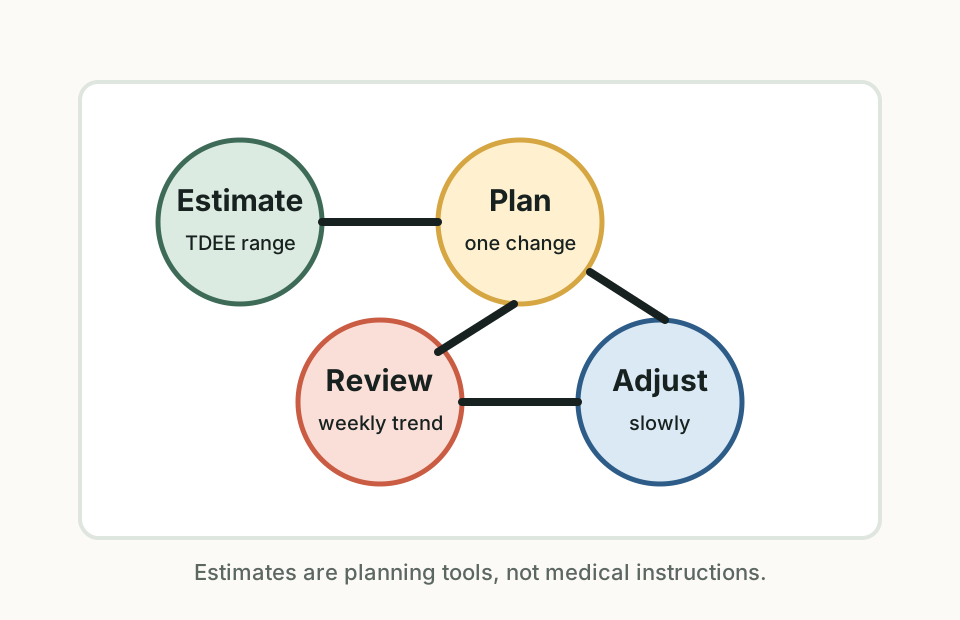
Common Starting Mistakes
Use these as a quick pressure test before turning a number into a plan.
- Starting with a strict diet label before knowing the real decision.
- Treating calculator output as measured truth instead of an estimate.
- Changing calories, protein, meals, movement, sleep, and tracking all at once.
- Ignoring symptoms, medication, harmful restriction, or clinician-set diet limits.
Recommended Next Reads
Use the next page that matches what changed after the first estimate.
Calorie Deficit CalculatorTurn an estimate into a bounded rangeUse this after a TDEE estimate when the next decision is a mild or moderate planning range.Protein CalculatorTurn body weight into a meal-planning rangeUse this when the next decision is meal structure, fullness, or spreading protein across ordinary meals.Maintenance and PlateausReview before changing againUse this when the first result raises questions about ranges, plateaus, or long-term review.How to Read a TDEE EstimateInterpret the first numberUse this after the first calculator result when the activity assumption needs a clearer explanation.High Protein Diet BasicsTurn protein range into mealsUse this after the protein calculator when the next problem is turning grams into repeatable meals.
Editorial Method
Each indexable page shows a review date and a transparent editorial responsibility chain.
Health education writing desk
FitBasis Editorial Team
The FitBasis Editorial Team writes general adult weight-management education from official public-health, nutrition, consumer-protection, and primary research source families. The team focuses on plain English, visible assumptions, practical next steps, and low-risk boundaries so readers can use calculators and guides without mistaking them for individualized medical care.
Source and usability editorFitBasis Content QA
FitBasis Content QA checks whether each page answers a real reader task instead of repeating generic advice. The role covers source alignment, calculator assumptions, reading flow, duplicated phrasing, internal links, examples, FAQ usefulness, and whether the next action can be tested in an ordinary week.
Editorial safety reviewerFitBasis Safety Boundary Review
FitBasis Safety Boundary Review checks that published pages stay inside general education. This review excludes high-risk topics from the indexable set, removes guarantee-style or shame-based wording, and makes sure medical history, symptoms, medication, harmful restriction, or clinician-set diet limits point readers toward qualified professional guidance.
Useful Starting Guides
Entry points for common first decisions after a calculator result.
How to start losing weight when you feel overwhelmedHow to start losing weight when you feel overwhelmed is the start here guide for a beginner who has read too much advice and cannot tell which first step matters; it focuses on choose one tomorrow-morning action and one thing that will stay unchanged and reviews whether the first action made the next day easier.How weight loss really works for beginnersHow weight loss really works for beginners is the start here guide for a beginner who wants the mechanism without turning it into a complete lifestyle rewrite; it focuses on separate the basic energy-balance idea from the ordinary-week routine you will test and reviews whether the chosen routine happened on ordinary days, not just perfect days.Calorie balance without diet culture languageCalorie balance without diet culture language is the start here guide for a reader who wants a neutral way to understand intake and output without shame language; it focuses on write the calorie-balance idea as an estimate-and-review question, not a morality score and reviews weekly average, hunger, energy, adherence, and whether the language stayed neutral.How to set a realistic first weight goalHow to set a realistic first weight goal is the start here guide for a beginner setting a first goal before the first two weeks have produced useful feedback; it focuses on choose a first goal small enough to test with normal meals and normal weeks and reviews whether the routine happened on ordinary days, not just perfect days.What to track in the first two weeksWhat to track in the first two weeks is the start here guide for a beginner opening a tracker before knowing which signal will change the next decision; it focuses on pick three useful signals for the first two weeks: one behavior, one trend, and one context note and reviews whether the tracked signals changed a real decision instead of just adding pressure.Scale weight versus body fat changesScale weight versus body fat changes is the start here guide for a reader trying to understand why one measurement feels louder than the real trend; it focuses on decide the measurement rule before seeing the number and reviews weekly trend, routine consistency, and whether the measurement rule stayed calm.How often to weigh yourself without spiralingHow often to weigh yourself without spiraling is the start here guide for a reader who wants trend feedback without letting the next scale number steer the whole day; it focuses on choose the weigh-in frequency and interpretation rule before stepping on the scale and reviews whether the rhythm produced useful trend context without increasing reactivity.What a gentle weekly check-in should includeWhat a gentle weekly check-in should include is the start here guide for a reader reviewing the week and trying not to turn the check-in into self-criticism; it focuses on write what happened, what helped, what got in the way, and one adjustment for next week and reviews whether the check-in produced one specific adjustment instead of a restart.
FAQ
Short answers for the decisions people usually make before their first week.
Where should I start on FitBasis?
Start with the TDEE calculator if you need a calorie context, the calorie deficit calculator if you already have an estimate, or the protein calculator if the next decision is meal structure. If the problem is not a number, use Start Here and pick one seven-day guide.
Are the calculators medical advice?
No. They are planning estimates for adults. They do not account for every medical condition, medication, symptom, harmful restriction history, clinician-supervised life stage, or clinician-set diet limit. Use professional guidance when those factors matter.
Why does the site keep linking to safety pages?
Weight-loss advice often becomes too certain too quickly. Safety links help readers check claims, urgency, very low targets, privacy issues, and situations where self-guided advice is not enough.
How do I avoid reading too many pages?
Use one page to answer one decision. If you cannot name the next action after reading, move to the hub page for that topic and choose the branch that describes the real situation.
What should I do after the first week?
Review whether the action happened, what interrupted it, how hunger and energy felt, and whether the result clarified the next decision. Repeat or shrink the action before making the plan stricter.
What should I not use FitBasis for?
Do not use FitBasis to diagnose unexplained weight change, manage disease-specific diets, override medical advice, or follow extreme restriction. Use the pages to prepare questions for qualified care when personal risk is involved.
Source Notes
- Google Search CentralUsed for people-first organization, crawlable page structure, clear titles, internal links, and avoiding thin doorway-style pages.
- CDC Healthy WeightUsed for gradual, sustainable adult weight-management framing and the idea that behavior changes should be realistic enough to maintain.
- NIDDK Weight ManagementUsed for safe program-selection questions and reminders to involve qualified professionals when personal medical context changes the decision.