Practical guide
Logging Training Volume: Sets, Repetitions and Minutes
Keep actual set rows, units and timing conventions visible. Unequal-set calculations, side and load examples, two blank records and six checks show which quantities can be combined and what a total cannot prove.
Start with the question, then choose a quantity
A useful training-volume log keeps sets, completed repetitions, external load and timed activity in separate fields. First write what you want to know: which exercise happened, how many movements you recorded, or how much time a particular activity occupied. These questions need different quantities.
A headline such as “volume: 60” is ambiguous. It could mean repetitions, minutes, a device score or something calculated from weight. State the unit and the row definition beside the number so you can understand the same record next week.
The NHS explains that a repetition is one complete movement and describes strength activity using body weight or resistance. Its adult activity guidance distinguishes muscle-strengthening activity from aerobic activity. Those definitions provide context; the tables and calculations here are original bookkeeping examples.
This record does not prescribe a workout, test exercise safety or calculate an appropriate dose. Use activities and technique instructions suitable for you, including existing professional guidance. The fictional amounts below demonstrate arithmetic, rather than a set or repetition target to follow.
| Quantity | What to record | Keep this distinction |
|---|---|---|
| Sets | Groups of repetitions actually completed, by category. | A set count does not contain the repetition count. |
| Repetitions | Actual movements in each set, under a stated convention. | A changed exercise version needs a new label. |
| External load | Recorded weight and unit, when relevant. | Say whether the number is for one implement or a pair. |
| Load-repetition total | An optional sum of recorded external load × repetitions. | Label kg-rep or lb-rep; this is not energy or a fitness score. |
| Activity minutes | Timed activity and the timing convention. | Moving, elapsed and rest-inclusive time differ. |
| Context | Equipment, assistance, category and missing values. | A number without its definition may not be comparable. |
Record actual sets before calculating a total
Use one row per set when repetitions or loads vary. Record the completed amount, rather than copying the intended number into every row. “Three sets planned” and “three sets recorded” describe different things if a set was not completed or its outcome is unknown.
Give the exercise a usable name or version, such as the same familiar movement on the same equipment. Keep the category visible if you separate preparation sets from main exercise sets. This article does not define a universal “working set” or decide which repetitions are suitable; it asks you to state the category you used.
The following invented record uses one external-load convention throughout. It contains three main exercise rows with unequal repetition counts and a load change. The task is to summarize the recorded rows accurately.
| Row | Actual repetitions | Recorded external load | Load × repetitions |
|---|---|---|---|
| Set 1 | 12 | 6 kg | 72 kg-rep |
| Set 2 | 10 | 6 kg | 60 kg-rep |
| Set 3 | 8 | 5 kg | 40 kg-rep |
| Recorded total | 30 | Different loads; retain the rows | 172 kg-rep |
The repetition count is 12 + 10 + 8 = 30. The optional load-repetition calculation is (6 × 12) + (6 × 10) + (5 × 8) = 172 kg-rep. Multiplying the planned pattern 3 × 12 × 6 gives 216 kg-rep, which does not describe these actual rows.
“Sets × repetitions × load” works as a shortcut only when the included completed sets share the specified repetition and load values. When they differ, calculate each row and add the compatible results. Retaining the rows makes the arithmetic checkable.
If a separate preparation row contains 5 repetitions at 3 kg, its arithmetic total is 15 kg-rep. Keep that category separate from the main-row total of 172. A deliberately combined-category report could state 187 kg-rep, but it would answer a different question and must name what it includes.
Define the load and side convention once
Write what the load number represents before multiplying. A log that says “6 kg” might mean one dumbbell, a pair, an equipment label or a value copied from a previous exercise. Use the same convention for comparable rows and label any change.
Consider a fictional exercise in which two 6 kg implements move together in each recorded repetition. If the record counts 8 complete movement cycles and declares the combined external load as 12 kg, its optional total is 12 × 8 = 96 kg-rep. Counting 16 movements while still using the combined 12 kg would count the two sides twice.
An alternative convention can record the sides separately: 8 movements with 6 kg on one side gives 48 kg-rep, and the same recorded amount on the other side gives another 48. The arithmetic reaches 96 for this stated example. Do not assume every exercise moves both sides together or that an incomplete side has the other side’s count.
Bodyweight and resistance-band activity also need a useful description. Record the version, assistance or band identifier and actual repetitions. Do not invent a fixed kilogram value for a band or treat your whole body mass as a directly comparable dumbbell load.
An external load of zero can be meaningful in a particular record convention, but it does not mean zero exercise or effort. “Bodyweight version; external-load total not used” is often clearer than making a zero-weight total the headline. The NHS includes bodyweight and resistance-band activity in its strength context; a useful log should preserve what the activity was.
Keep kg and lb entries separate unless you deliberately convert them and document the conversion. Changing a unit label does not convert the number. This worksheet avoids mixing those units in one total.
Keep minutes beside the strength record, with their own meaning
A session can contain several real quantities without needing one combined score. You can record strength sets and repetitions, bodyweight activity and cycling minutes in the same journal while keeping their summaries separate.
| Entry | Recorded amount | Useful description |
|---|---|---|
| Main strength rows | 3 sets; 30 repetitions; optional 172 kg-rep | The defined exercise rows above. |
| Bodyweight version | 2 sets of 5 movements | Version and assistance recorded; no external-load score needed. |
| Cycling activity | 25 moving minutes | Time spent moving, under the stated timing method. |
| Cycling session | 35 elapsed minutes | Includes the same 25 moving minutes and 10 minutes of pauses. |
Do not add 30 repetitions to 25 minutes and call the answer “55 volume.” Likewise, adding the cycling session’s 35 elapsed minutes to its 25 moving minutes would count the same activity period twice. Pick the timing quantity that answers your question and label the other as context.
Minutes from different activities can be described in a time-use record, but equal minutes do not establish equal training or effort. If you combine activity minutes, identify which activities and timing conventions are included rather than presenting a single dose score.
The NHS adult guidance explains that muscle-strengthening activities are not always aerobic activity. A clock running during a strength session therefore does not automatically turn all its minutes into moderate aerobic minutes. This log does not classify an activity’s intensity, convert strength time into aerobic guidance or prescribe a weekly target.
Keep an effort note if it helps describe the task, using words appropriate to your record. Do not treat soreness, exhaustion or a larger device estimate as proof that the count was better or that more activity is needed.
Compare compatible records without making the total an outcome
An optional external-load repetition total is a calculation from your recorded inputs. It is not mechanical work, which would require information this log does not contain, and it is not energy expenditure, muscle growth, exercise quality or a safety assessment.
A larger total may reflect more counted repetitions, a different load, a changed exercise, a category change or a different recording convention. Start by identifying which of those changed. A precise result from the arithmetic does not make the interpretation equally precise.
| Change | Record it explicitly | Limit of the comparison |
|---|---|---|
| Unit or load convention | kg versus lb; one implement versus a pair. | Resolve the definition before subtracting totals. |
| Equipment or exercise version | Machine identifier, assistance or movement version. | Do not rank unlike tasks by one load-repetition number. |
| Included category | Main rows only, preparation only, or a stated combined group. | A category change can alter the total without changing the same task. |
| Missing load or repetition value | Known fields plus the specific unknown. | An incomplete subtotal does not describe every row. |
For a repeated familiar task, retain the equipment, version, instructions and relevant rest or assistance notes. Compare the subset whose definitions match. If those details differ, describe the change rather than calling the larger number a gain in the original task.
If your question is whether a planned session happened, use the separate workout adherence guide. If it is whether repeated observations justify calling an outcome a plateau, use the progress comparison checklist. This article supplies quantity definitions and row arithmetic for those later reviews.
Keep gaps and concerns visible instead of filling the log
A missing repetition or load field stays unknown. If two sets are known to have happened but their counts were not recorded, you know the set count; you do not know the repetition total. If repetitions are known but the external load is missing, retain the counts and leave the optional load calculation incomplete.
Summarize that limit in words: “30 documented repetitions; another set’s count unknown,” or “two known rows have a subtotal; one load value is missing.” Do not copy a usual value into the gap or mark it zero to obtain a tidy total.
Keep the journal proportionate. A simple private note may be enough, and you can omit the optional load-repetition total entirely. More fields are useful only when they answer a practical question without creating pressure to complete extra exercise.
NHS guidance asks people to match activity and intensity to their fitness and speak to a GP after prolonged inactivity or with medical conditions or concerns. Follow relevant instructions for your situation. Pain, unusual symptoms or concerning recovery need appropriate guidance; completing a row or improving a total is not a reason to continue despite a concern.
If tracking creates distress, harmful restriction or pressure to compensate with exercise, simplify or pause the self-directed record and seek suitable support. A number describes recorded activity. It does not create exercise debt or decide what you should eat.
Copy a set record and a separate summary record
Use the first record for actual rows and the second for a period summary. Choose only the fields relevant to your activity. A paper note works; no public upload, account or device is required.
TRAINING RECORD - ACTUAL SET ROW
Date and session ID:
Exercise version and equipment:
Set category / set number:
Actual completed repetitions:
External load and unit, if used:
Load convention: one implement / pair / other:
Repetition convention: one side / both moving together:
Relevant rest, assistance or technique note:
Unknown field and what remains known:
Question or concern for appropriate guidance:
TRAINING SUMMARY - KEEP THE QUANTITIES SEPARATE
Period and the question this summary answers:
Exercise version and compatible row IDs:
Included set category / excluded category:
Known set count and actual repetition total:
Optional external-load repetition total and unit:
Activity minutes and the activity being timed:
Moving / elapsed / rest timing convention:
Missing values or changed equipment:
What the recorded comparison can establish:
What it cannot establish / next useful note:
Download both records, the unequal-set example and six explained checks (TXT).
Before sharing a summary with a qualified professional, retain the original rows and mark the question you want help with. “These are the activity versions and missing fields” is more useful than presenting an unexplained score as a conclusion.
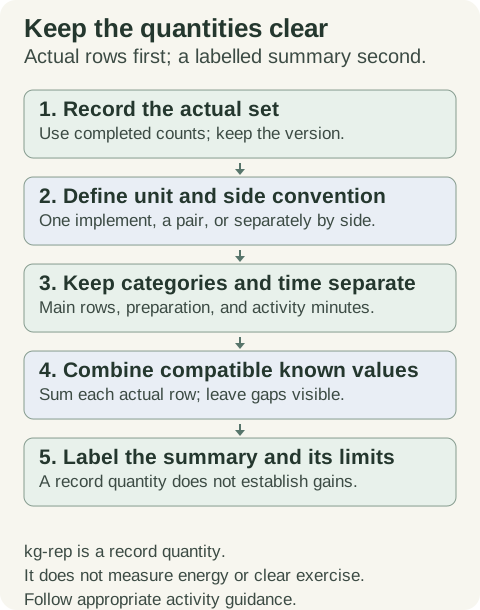
Check six fictional records before trusting the summary
These cases test the bookkeeping conventions above. The people and amounts are invented; no physical training trial or observed fitness improvement is claimed.
Case 1
Three recorded sets contain 12, 10 and 8 repetitions. Is the actual count 3 × 12 = 36?
Show answer and explanation for case 1
No. The recorded repetition total is 12 + 10 + 8 = 30.
Multiplying a nominal 12 by three replaces the two smaller actual counts. Use the completed row values when sets differ.
Case 2
The loads and repetitions are 6 kg × 12, 6 kg × 10 and 5 kg × 8. What does the optional total equal?
Show answer and explanation for case 2
72 + 60 + 40 = 172 kg-rep, for those stated rows and convention.
Calculate each row before adding. The total is a labelled external-load repetition quantity; it does not measure energy, safety or a training outcome.
Case 3
Two 6 kg implements move together for eight recorded cycles. The log uses the combined 12 kg load. Should it multiply by 16?
Show answer and explanation for case 3
No. Under that convention, 12 × 8 = 96 kg-rep.
The combined load already includes both implements. Counting each side again as 16 while retaining that combined load would count the sides twice.
Case 4
A journal contains 30 strength repetitions and 25 cycling minutes. Is “55 total volume” a usable combined score?
Show answer and explanation for case 4
No. Keep the two quantities and their units separate.
Repetitions and minutes answer different questions. A single addition does not define a common training quantity or establish equivalent effort.
Case 5
Cycling took 35 elapsed minutes, including 25 moving minutes. Does adding both give 60 activity minutes?
Show answer and explanation for case 5
No. The 25 moving minutes are already within the 35 elapsed minutes.
State the timing convention instead of counting the same period twice. The log can preserve both values as separate descriptions.
Case 6
The repetitions are known, but one external load is missing. Should the load be entered as zero so the calculation finishes?
Show answer and explanation for case 6
No. Keep the known repetitions and the unknown load visible.
A missing measurement is not a recorded zero. Any subtotal must name the rows it covers and the gap; do not invent a load or use the summary as exercise clearance.
Sources and further reading
- NHS: Strength exercisesControlled movement examples, gradual activity and a concrete example of sets and per-side repetitions; no example amounts copied as a personal program.
- NHS: Physical activity guidelines for adults aged 19 to 64Activity appropriateness, health concerns and the distinction between aerobic and muscle-strengthening activity.
- NHS: How to improve your strength and flexibilityRepetition and set definitions, bodyweight and resistance context, and the distinction between strength time and aerobic activity.
Understand the movement you are recording
A repetition count needs a named movement. Read its specific setup and complete steps before using a total.
- Sit-to-Stand vs Mini-Squats: Chair Setup and NHS Steps
- Wall Press-Ups at Home: Setup, NHS Steps and Set Counts
- Side Leg Lifts vs Backward Leg Raises: NHS Directions
These source-guided explanations keep the actual movement distinct from an arithmetic total.