Practical guide
Fitness Progress Plateau or Missing Data? A Review Checklist
Before calling an unchanged result a plateau, check what the measure answers, whether the task and conditions are comparable, and which observations are missing. Use two records to choose a useful next review step.
First ask what “no progress” means in your record
A flat number is not enough to establish a fitness plateau. First check whether the number measures your goal, whether the observations describe the same task and whether missing entries make the comparison uncertain. A recording gap and a repeatable unchanged result need different next steps.
“I attended the planned walks,” “this route felt more manageable” and “my weight changed” are three different statements. Completing a routine can be a useful achievement while another outcome stays unchanged. Conversely, one unusually fast walk does not show that your whole routine is improving. Write one question before opening the spreadsheet: for example, “Did I repeat the lunch walk I planned?” or “How did the same familiar route compare under similar conditions?”
The CDC's steps for losing weight recommend tracking where you are, using specific realistic goals and regularly revisiting the parts of a plan that work or need changing. NIDDK's program guidance also emphasizes goals, barriers, feedback and activity appropriate to a person's health and ability. The checklist below applies those planning ideas to your record. It is an original review aid, not a validated plateau test or a way to diagnose why an outcome has stopped changing.
Choose a measure that answers your actual question
Use a small set of useful fields rather than collecting every available device number. One behavior measure and one task-specific observation may be enough for your current question. Keep medical measurements under the instructions of the professional who requested them.
| Question | Useful record | Necessary context | What this alone cannot show |
|---|---|---|---|
| Did I do the routine I planned? | Originally planned opportunities, actual attendance and actual activity. | Plan dates, moved or cancelled sessions and unknown outcomes. | Improved fitness, weight loss or the quality of every session. |
| Is this familiar walk becoming easier to repeat? | The same route or defined task, duration and a brief effort note. | Stops, hills, weather, load carried and changes in route. | A cause of the change or a clinical fitness assessment. |
| How did the same strength task compare? | Exercise version, equipment, sets and repetitions recorded separately. | Technique or range instructions, assistance and rest arrangement. | That more repetitions with a changed task mean greater strength. |
| What does my agreed weight record show? | Dated readings using the same units and agreed measurement method. | Missing readings, device changes and the plan followed with your care team. | Body-fat change, metabolic adaptation or a calorie prescription. |
| Is the routine workable in my week? | Actual time and access constraints; what happened when the plan changed. | Work, caring, transport, sleep and appropriate recovery needs. | That a difficult week reflects laziness or a need for punishment. |
Write the measure's definition in plain language. “Session completed” might mean arriving, doing any activity, or completing the originally planned task; those are different counts. For a defined plan-and-actual record, use the workout adherence tracking guide. This article starts with the next question: whether the available observations support a useful comparison.
Do not turn an optional outcome into the only measure of success. NIDDK notes that physical activity has important health benefits independent of weight loss. A scale reading therefore cannot stand in for every activity or fitness outcome.
Check whether you are comparing the same task
Conditions do not need to be perfectly identical for a record to help. They do need to be clear enough that a change is not silently attributed to fitness. Put a short note beside the observation when an important condition changes; compare a suitable subset or describe the difference instead of forcing every entry into one ranking.
| Check | What to make explicit | If it changed or is unknown |
|---|---|---|
| Goal and task | The question and the actual activity being compared. | Separate unlike tasks instead of calling one a better result. |
| Definition and unit | Minutes, repetitions, distance or another clearly defined measure. | Resolve units and definitions before subtracting numbers. |
| Route or exercise version | Route, hills, assistance, equipment and intended movement. | Label the new version; keep the original entries. |
| Measurement method | Same timing method or device and an agreed procedure. | Mark a method change; do not assume readings are interchangeable. |
| Stops and rest | Whether the timing includes pauses and how rests were arranged. | Distinguish elapsed time from moving time; record relevant changes. |
| Effort and control | A plain-language effort note and the technique instructions followed. | Do not improve a number by changing the task or ignoring symptoms. |
| Relevant conditions | Weather, load carried and unusual schedule or recovery context. | Treat these as possible context, not proof of a cause. |
| Observation coverage | Dates, number of recorded opportunities and missing entries. | State what is absent before describing the pattern. |
The CDC explains aerobic activity intensity using effort and the ability to talk: during moderate activity you can talk but not sing; during vigorous activity you generally cannot say more than a few words without pausing for breath. It also stresses that the same activity can feel different to people with different fitness and health. A brief effort note can add context, but it is not a calibrated test, medical screening result or target to chase.
For strength records, a repetition is a complete movement and a set is a group of repetitions. Record the exercise version and instructions as well as the count. This guide does not tell you to train to failure, change a prescribed technique or repeat a difficult task merely to obtain comparable data.
Separate a missing entry from a recorded zero
An empty field means you do not have that recorded value. It does not automatically mean no activity happened. You may know that a session was missed, know that some activity occurred but lack its duration, or know nothing about that opportunity. Keep those states separate.
| Known situation | Honest entry | Conclusion you can make |
|---|---|---|
| You know the planned walk did not happen. | Missed; zero activity for that specific planned opportunity. | The planned opportunity was not attended; unrelated activity is a separate entry. |
| You know the walk happened but did not record its time. | Attended; duration unknown. | Attendance is known, but the activity-minute total is incomplete. |
| There is no entry and you cannot reliably recall the outcome. | Outcome unknown; no invented duration. | The period has a coverage gap; neither attendance nor duration is established. |
| The plan moved and the new date is known. | Original date and status; actual new date and result. | You can review the move while preserving what was originally planned. |
| A device failed or its method changed. | Record the failure or method change and any reliable remaining facts. | Some fields may remain useful; the missing measurement is not recovered by guessing. |
For example, one fictional week has three planned walks. Two are recorded as 20 minutes each, while the third outcome is unknown. The record establishes 40 documented minutes and two known attendances. It does not establish exactly 40 total minutes or complete attendance of two out of three. If you later confirm the third was missed, date that correction and record the source of the information; do not fill it with a typical duration to make the week look smoother.
Likewise, “the average of three recorded observations” is a narrower statement than “my weekly average” if other intended observations are missing. Averages can summarize recorded numbers, but cannot recover missing ones or repair a changed measurement method. Show the dates and number of observations alongside any summary.
The next step may be a smaller, easier recording method: write the activity and actual amount soon afterward, or make a private paper note when the device is unavailable. You do not need to reconstruct every forgotten number. Keep “unknown” and start a clearer record from a stated date.
Read repeated observations without inventing a plateau deadline
A single low-energy day, fast result or unchanged reading is an observation, not a complete trend. Look across repeated comparable observations and describe what is actually recorded: the dates, task, amount, coverage and range of results. If the record is short or inconsistent, say that the comparison remains uncertain.
There is no universal number of flat days or weeks in this worksheet that proves a plateau. The useful review point depends on the question, the opportunities you had to repeat the activity, the measurement method and any professional instructions. A familiar routine that occurs twice in a period cannot provide the same observation coverage as one recorded daily. Neither schedule becomes a medical threshold just because it is convenient for a spreadsheet.
For an outcome such as weight, keep the context of your agreed care or program plan. Do not use this checklist to infer body-fat change, diagnose a metabolic problem, or set a new calorie deficit. NIDDK advises discussing weight, medical problems, medicines and supplements with a health care professional and looking for ongoing feedback. Bring the dated record and the unresolved question to that conversation.
Even a consistent change does not establish its cause. A quicker route time after a schedule change might involve effort, conditions, stops or practice as well as fitness. You can document the difference without claiming that one factor caused it. If you change a plan appropriately, date the change and retain the earlier record rather than redefining what happened.
Choose between repairing data, retaining a routine and asking for help
Use the review to identify the next useful question, rather than to create exercise debt or food compensation. If the result is unclear because the task definition or coverage changed, repair that specific recording gap. If the routine is appropriate and workable, you may retain it while gathering a clearer record at your agreed review point. That is a planning choice, not a promise that an outcome will improve.
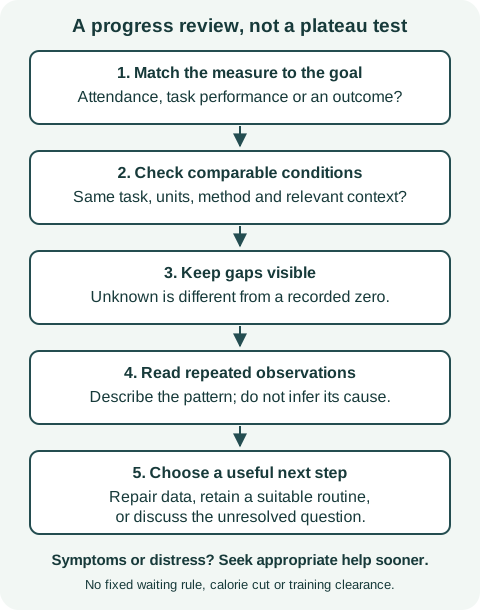
If repeated comparable observations leave a concern unresolved, ask a clinician or qualified exercise professional to help interpret the relevant question. Bring the original plan, actual results, context notes and changes already made. “These are the dates and observations; what should I review next?” is more useful than presenting a guessed cause as settled.
Do not wait for a longer pattern when pain, unusual symptoms, illness or concerning recovery changes occur. Stop the activity as appropriate and seek suitable guidance; severe or urgent symptoms need urgent or emergency help. Follow existing professional instructions for health conditions, pregnancy, injury or disability. Making the activity smaller does not by itself resolve a health concern.
If tracking increases distress, guilt, harmful restriction or pressure to compensate with exercise, pause the self-directed review and discuss the difficulty with an appropriate professional. More entries are not automatically more useful. A less detailed record, or no weight record, may be the appropriate arrangement for your situation.
Four fictional comparisons show what the data can and cannot say
These examples are invented to demonstrate record interpretation. They are not tested training programs, assessed participants or evidence of a particular improvement.
1. A flat-route walk is compared with a hilly walk
The first entry is 18 minutes on a flat loop. The next is 23 minutes on a different route with hills and a stop at a crossing.
Useful conclusion: these are two recorded walks with different tasks and conditions. The longer time does not establish declining fitness.
Keep both records and label the routes and stops. If a same-task comparison is useful and appropriate, record future instances of that task without adding extra walks solely to satisfy the spreadsheet.
2. More repetitions come from a different exercise version
A person records eight repetitions in one familiar exercise version, then twelve in a version with more assistance. Rest arrangements were also different.
Useful conclusion: the second number is larger, but the record does not establish improved performance in the original task.
Record the versions, assistance and rest separately. Follow the applicable technique and health instructions; do not remove needed assistance to make the numbers look comparable.
3. The recorded minutes fall while coverage also falls
Week A has three recorded walks of 20 minutes each. Week B has two recorded walks of 20 minutes each and one unknown outcome.
Useful conclusion: documented minutes fell from 60 to 40, while the complete activity total for Week B is unknown. That is not proof that actual activity fell by 20 minutes.
The next useful improvement is a clear outcome entry. Keep the gap visible instead of treating the blank as zero or filling it with 20 minutes.
4. Attendance improves while an optional weight outcome is unchanged
A person follows an agreed routine more consistently and has several unchanged weight readings. They want to conclude that the activity did nothing.
Useful conclusion: the attendance record answers whether the routine happened. The weight record answers a separate, limited question and does not erase that behavior change.
Review each measure under its own definition. If weight management is a care goal, discuss the appropriate method and next step with the relevant professional; do not infer a need to cut calories from this example.
Copy two records and check six common interpretations
Use the first record to describe the comparison, and the second to choose the next review action. Leave unknowns visible. A dated paper note is enough; no app, public upload or exhaustive daily dashboard is required.
FITNESS PROGRESS — COMPARISON RECORD
Goal and the specific question I want to answer:
Measure, unit and reason it matches that question:
Task version / route / equipment / technique instructions:
Period A: dates, planned opportunities and actual observations:
Period B: dates, planned opportunities and actual observations:
Missing entries and whether the outcome is known:
Conditions that changed between observations:
What the recorded comparison shows:
What it cannot establish:
Health or recovery concern needing guidance:
NEXT REVIEW — DATA OR PLAN CHANGE
Known facts from the dated record:
Unresolved comparison or missing field:
Smallest useful recording improvement:
Appropriate routine or professional instructions to retain:
Next review date or agreed review point:
Reason for that timing, rather than a universal plateau deadline:
If changing the plan: what, when, why and who advised it:
Which old entries remain unchanged:
Question for a clinician or qualified exercise professional:
This worksheet does not diagnose a plateau or prescribe calories or exercise.
Download both blank records, the three checklists and six explained cases. The questions help separate useful evidence from assumptions; they do not score your fitness or prescribe a training or weight-loss plan.
Case 1
A familiar walk takes longer on a new hilly route with more stops. Does the time alone prove a fitness plateau?
Show answer and explanation for case 1
No. The task and conditions changed, so the direct comparison is limited.
Record the route and stops. Different elapsed times do not establish a fitness change when the activity being measured is different.
Case 2
A session happened but its duration is missing. Should its activity-minute field be entered as zero?
Show answer and explanation for case 2
No. Attendance is known; duration is unknown.
A blank measurement and a confirmed missed session are different states. Keep the known fact and the missing field separate rather than inventing a value.
Case 3
Three recorded readings have an unchanged average, but several intended readings are missing. Does that prove a plateau for the whole period?
Show answer and explanation for case 3
No. It describes those three observations, with incomplete coverage.
State the dates, method and number recorded. A summary of available values cannot recover missing observations or diagnose why an outcome is unchanged.
Case 4
Twelve assisted repetitions are compared with eight less-assisted repetitions. Is the larger count sufficient evidence of improvement in the same task?
Show answer and explanation for case 4
No. The exercise version and assistance must be part of the record.
More repetitions can be useful to document, but a changed task is not automatically a stronger result in the original task. Keep technique and appropriate support in view.
Case 5
An appropriate routine is repeatable, but the spreadsheet lacks route and timing definitions. What is the smallest useful next review change?
Show answer and explanation for case 5
Clarify the task and measurement method, and mark earlier limitations.
A recording improvement addresses the known gap. It does not require replacing the whole routine, adding punishment sessions or changing food intake.
Case 6
Pain or concerning symptoms occur before enough observations have accumulated. Should you keep exercising until the planned review date?
Show answer and explanation for case 6
No. Stop as appropriate and seek suitable guidance sooner.
A data review cannot clear symptoms or impose a waiting period. Urgent concerns need urgent or emergency help, and existing professional instructions take priority.
Sources and further reading
- CDC: Steps for Losing WeightActivity recording, specific realistic goals, regular plan review and seeking advice about weight or medicines.
- CDC: What Counts as Physical Activity for AdultsActivity effort, individual differences and the distinction between repetitions and sets.
- NIDDK: Choosing a Safe and Successful Weight-loss ProgramAppropriate activity, goals and feedback, benefits independent of weight loss and questions for a health care professional.
Identify the saved object
If the number came from a FitBasis calculator, check which inputs its saved snapshot actually retains. An output saved on another date is not an additional body measurement.