Practical guide
Choosing Two, Three or Four Workout Days: A Time-Budget Worksheet
Compare two, three and four visits against the same calendar budget. Count the time around each session, check each real day, and keep the reserved block separate from actual activity. Use the calculator, fictional examples and a written record to see what still needs an answer.
Start with the time you can actually reserve
Choosing two, three or four workout days starts with two separate questions: which days can actually work, and how much time each visit takes from the calendar. A four-day arrangement may offer shorter visits but require travel and preparation four times. Two visits may use fewer transitions while needing longer individual windows.
This worksheet compares those time costs. It does not choose a bodybuilding split, prescribe intensity or rank the health results of different frequencies. First identify an activity or routine appropriate to you; then test whether its arrangement fits the available week.
The NHS adult guidelines include muscle-strengthening activity involving the major muscle groups on at least two days, alongside separate aerobic activity and reducing prolonged sitting. “Two strengthening days” is not a statement that any two visits, regardless of content, meet all activity guidance. Your whole activity pattern remains a different question.
Write the actual start, finish, place and access for each candidate visit. Keep sleep, essential responsibilities and relevant recovery needs on the calendar. A schedule that repeatedly borrows from an unavailable window has a constraint to resolve, even if its weekly sum is attractive.
Define calendar time, overhead and the session block
Calendar time is the full window you can reserve. Overhead is time around the session: travel, changing, finding equipment, setup, finishing and returning to the next commitment. Split it into before and after if that helps avoid omissions.
The session block is the reserved period for the activity itself, including its appropriate warm-up, rests and cool-down. It is not a count of uninterrupted effort or automatically moderate-intensity minutes. Do not remove necessary parts of an established activity to make the subtraction look better.
Use the formula calendar time = overhead + session block for one visit. Across a candidate count, total overhead = visits × overhead per visit. These equal-overhead formulas are a simplified model: if locations or travel differ, use the individual visit records instead.
Record a measured or realistically checked travel allowance, not an ideal fastest journey. Opening hours, equipment access, waiting and the return journey can change the answer. A familiar home option may reduce travel while still needing setup and suitable instructions.
Compare two, three and four visits with the same budget
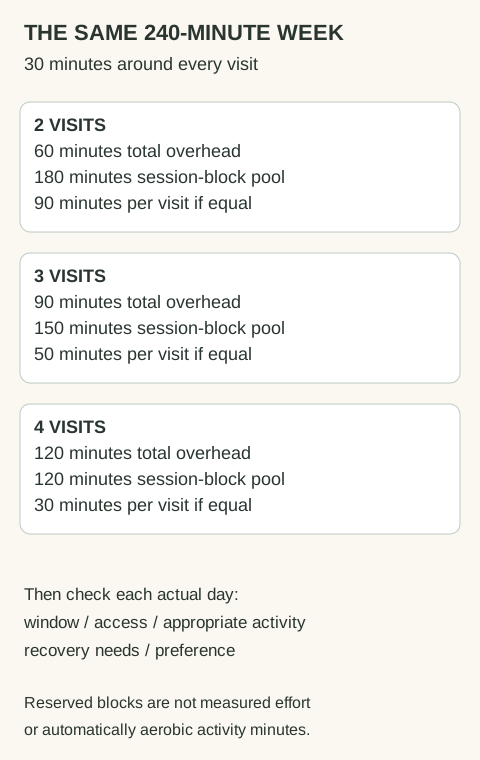
Here is a fictional 240-minute calendar budget with 30 minutes around each visit. The overhead and session blocks are invented for arithmetic; none is a recommended session length or preparation allowance.
| Visits | Calendar budget | Total overhead | Session-block pool | Equal block per visit |
|---|---|---|---|---|
| 2 | 240 min | 60 min | 180 min | 90 min |
| 3 | 240 min | 90 min | 150 min | 50 min |
| 4 | 240 min | 120 min | 120 min | 30 min |
For two visits, 240 − 2 × 30 = 180 minutes remain in the session-block pool. For three, the pool is 150; for four, it is 120. Divide each pool by its visit count to obtain the equally divided blocks shown.
The extra visits consume more overhead in this model. That explains the different pool; it does not establish that the two-day arrangement is better training. A shorter session might suit someone’s routine, while longer windows may be unavailable or unwanted. The activity and the person still matter.
Suppose the example instead aims to reserve a 45-minute block per visit. It needs 2 × (30 + 45) = 150 calendar minutes for two, 225 for three and 300 for four. Against 240, the margins are +90, +15 and −60. Spare calendar time can remain spare; it is not an instruction to increase exercise.
Check each real window instead of relying on the sum
A weekly budget does not establish how many days are available. In this second fictional record, the same 240 total minutes exist on only three days. The individual windows also differ.
| Day | Real window | Visit overhead | Session block left |
|---|---|---|---|
| Monday | 90 min | 30 min | 60 min |
| Tuesday | Unavailable | — | — |
| Wednesday | 75 min | 30 min | 45 min |
| Thursday | Unavailable | — | — |
| Friday | 75 min | 30 min | 45 min |
| Saturday | Unavailable | — | — |
| Sunday | Unavailable | — | — |
The 90-minute Monday window leaves 60 after the stated overhead; Wednesday and Friday each leave 45. That can accommodate three 45-minute blocks in the arithmetic, with 15 spare on Monday. It cannot create a fourth day, and it does not prove the activity arrangement or recovery spacing is suitable.
For any candidate, write the selected days and compare each window with that visit’s overhead and desired block. If a window is too small, mark it unresolved. A large spare Saturday does not extend an already occupied Tuesday.
Keep access checks specific: the location is open, the intended activity is available, and any needed assistance is confirmed. If the weekly schedule changes, date the change and recheck the affected windows before treating the earlier choice as current.
Use the calculator to compare time costs
Enter the weekly calendar budget, before- and after-visit allowances, and the block you want to reserve. The tool displays two different questions: how an equal split would use the budget, and whether your desired block fits the weekly total for each visit count.
The starting values are the fictional example above. Change them to explore your own checked assumptions. The calculator does not select days, check recovery, measure actual activity or assess exercise suitability. Its inputs and results stay in this page session and are not saved as a health record.
If overhead alone exceeds the budget, the equal session block is unavailable. If the desired arrangement exceeds the budget, the result shows the shortfall. Treat that as an arrangement to change or a constraint to discuss, rather than a negative workout duration or a reason to rush necessary preparation.
The tool rounds displayed minutes to two decimal places. Keep useful realistic allowances instead of treating a fractional result as the precision needed for an exercise session. Use the formulas and written tables if you prefer a paper record.
Add recovery, preference and activity checks to the choice
A candidate that fits on paper is ready for further questions. Does its activity match your current ability and relevant instructions? Do the particular days and session contents make sense together? Does it leave you able to manage the rest of the week?
Preference matters because the arrangement has to be used: fewer journeys, shorter visits, a familiar class or a home setting can change which option you want. Record the preference beside the practical constraint, rather than declaring one frequency universally best.
The NHS strength-exercise examples emphasise controlled movement and building up gradually. A time saving does not itself justify increasing load or rushing repetitions. Ask a qualified exercise professional for suitable instruction when exercise selection, equipment or progression is unclear.
If you have not exercised for some time or have medical conditions or concerns, the NHS advises speaking to a GP first and matching activity and intensity to fitness. A budget result cannot resolve injury, pain or a recovery concern. Follow relevant care guidance rather than treating a shorter block as clearance.
Record the choice and keep actual activity separate
Write one candidate arrangement for the current period: the chosen days, each window, the activity or instructions, and the assumption still needing confirmation. You can choose two days because they are the days you can use, without calling them a failed four-day plan.
Keep a dated revision if the arrangement changes. After the period, record the actual visits and activity. That makes it possible to tell a planning mismatch from a change in access, an omitted entry or an activity concern.
Open the time-budget record, fictional calculations and eight answer notes. Use the blank fields in a private note or print them. The file is a planning aid, with no required training dose or predicted result.
For changes in the size of an upcoming week, the separate busy, usual and spacious goal ladder gives one activity three arrangements. This comparison holds the weekly budget constant and examines visit overhead and actual-day feasibility; the two tools answer different planning questions.
Use the planned-versus-completed record after the visits. Reserved session blocks belong in the plan; actual activity duration and type belong in the result. Do not automatically convert a strength reservation with rests into an aerobic-minutes total.
Read the time-cost map and check eight examples
Try the arithmetic or name the unresolved check before opening each answer. These fictional cases examine time quantities, real-day availability and the limits of the calculation.
Case 1
You have 240 weekly calendar minutes and allow 30 minutes around each visit. How much session-block time remains with four visits?
Show answer and explanation for case 1
240 − 4 × 30 = 120 minutes, or 30 per visit if divided equally.
The 120-minute total is reserved session-block time. It includes whatever warm-up, rests and finishing activity belong inside the block; it is not a measured aerobic total.
Case 2
The same budget with two visits leaves 180 session-block minutes. Does that prove two days produces better results than four?
Show answer and explanation for case 2
No. It shows a difference in the stated time budget.
Frequency, actual activity, suitability and outcomes are different questions. The arithmetic does not compare muscle growth, strength, cardiovascular benefit or weight change.
Case 3
A desired 45-minute block needs 30 minutes around each visit. Does three visits fit a 240-minute weekly budget?
Show answer and explanation for case 3
Yes in the total: 3 × (30 + 45) = 225 minutes, leaving 15 minutes.
Each chosen window still needs to accommodate its visit. Three suitable real days and the actual activity arrangement remain separate checks.
Case 4
Your only available windows are Monday, Wednesday and Friday. Can a calculator result showing a four-day total create a fourth visit?
Show answer and explanation for case 4
No. A weekly sum cannot create another available day.
List the actual windows before choosing the count. An unavailable day remains unavailable even if the combined arithmetic looks possible.
Case 5
With a 120-minute budget, 70 minutes around each visit already costs 140 minutes for two visits. What should the result show?
Show answer and explanation for case 5
The two-visit overhead alone exceeds the budget by 20 minutes.
There is no nonnegative session block left under those assumptions. Record the constraint; do not present a negative block as a workout length or rush preparation to repair it.
Case 6
A familiar home arrangement reduces travel time. Must all the saved time become harder exercise?
Show answer and explanation for case 6
No. Decide what to do with the available time deliberately.
A location change can reduce rushing or leave spare time. It does not establish that more load, intensity or duration is appropriate.
Case 7
You reserved a 50-minute strength session including warm-up and rests. Can you record 50 moderate aerobic minutes automatically?
Show answer and explanation for case 7
No. Record the actual activity and relevant duration or intensity separately.
The NHS distinguishes muscle-strengthening and aerobic activity. A calendar reservation does not establish the quantity or intensity actually performed.
Case 8
Two visits fit the calendar but you have an unresolved injury or recovery concern. Is “fits the budget” exercise clearance?
Show answer and explanation for case 8
No. Follow your relevant care instructions and seek appropriate guidance.
Time arithmetic cannot assess symptoms, injury or a safe exercise version. The NHS advises speaking to a GP about medical conditions or concerns and matching activity to fitness.
Sources and further reading
- NHS: Physical activity guidelines for adults aged 19 to 64Separate strengthening and aerobic activity context, appropriate activity and intensity, and speaking to a GP after inactivity or with medical concerns. The worksheet does not establish that weekly guidance is met.
- NHS: Strength exercisesControlled movement, suitable setup and building up gradually. Its specific home exercises are examples, not validation of the fictional time budgets or a personal lifting plan.