Practical guide
Heel-to-Toe Walking vs One-Leg Standing: Steps, Seconds and Support
Compare forward heel-to-toe steps with a wall-supported one-leg lift. Keep the NHS gaze, hip, support and side cues attached to their own step or timed-hold count.
A walking step and a standing hold answer different questions
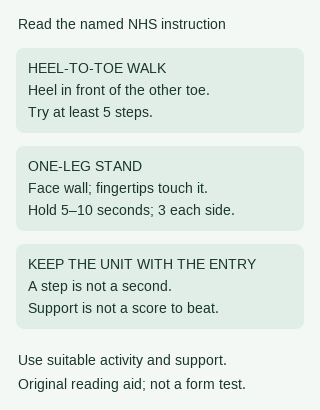
Heel-to-toe walking places one heel directly in front of the other foot’s toe, then continues forward. A one-leg stand lifts one leg while the other supports you. The NHS explains these as separate exercises and counts them differently: walking steps versus timed lifts.
Keep the support and gaze cues with the named entry. Do not use a 5-second hold as a substitute for 5 walking steps, or assume that one exercise’s progression applies to the other.
This guide explains the named NHS public exercise entries. Wear comfortable loose clothing, keep water handy and build up gradually. Choose activity and intensity appropriate to your fitness. NHS adult guidance advises speaking to a GP first if you have not exercised for some time or have medical conditions or concerns. Individual instructions take priority; an unstable setup or unsuitable movement is a reason to resolve the difficulty rather than complete a webpage’s count.
Heel-to-toe walk: place the heel, then alternate
- Stand upright.
- Place the right heel on the floor directly in front of the left toe.
- Next place the left heel directly in front of the right toe.
- Keep looking forward throughout.
- If necessary, put your fingers against a wall for stability.
The NHS says to try at least 5 steps and, as you progress, move away from the wall. That is the source’s progression wording; it supplies no fixed date or test for deciding when an individual should remove support. A useful first question is whether the instruction and support are appropriate and clear, not how quickly you can become unsupported.
This entry is not a tiptoe walk or a race. Each new heel-to-toe placement is a walking step under this description; it is not a timed stationary lift.
One-leg stand: face the wall and keep the hip cue visible
- Stand facing the wall with arms outstretched and fingertips touching it.
- Lift the left leg.
- Keep the hips level and a slight bend in the opposite, supporting leg.
- Hold the lift for 5–10 seconds according to the source wording.
- Gently place the foot back on the floor; the entry says perform 3 on each side.
The source’s facing-the-wall setup differs from fingers-at-a-wall while walking forward. Do not combine the two into a new exercise and attribute it to the NHS. The timed lift is part of a full lift-and-return sequence; the rest arrangement and personal suitability are not determined by the arithmetic.
If the support, position or movement is unsuitable, seek guidance addressing that difficulty. This article does not give a personal balance test, fall-risk threshold or rehabilitation progression.
Read the support and amount as one complete instruction
Swipe within the table on a narrow screen, or focus it and use the right-arrow key.
| Check | Heel-to-toe walk | One-leg stand |
|---|---|---|
| Position | Upright, placing a heel ahead of the other toe. | Facing the wall; one leg lifts. |
| Support | Fingers against a wall if necessary. | Outstretched arms; fingertips touch wall. |
| Position cue | Keep looking forward. | Hips level; slight bend in supporting leg. |
| Amount wording | Try at least 5 steps. | Hold 5–10 seconds; perform 3 each side. |
| Unit to retain | Walking steps. | Timed holds plus side-labelled repetitions. |
A record saying “balance: 6” loses the distinction between six steps, six holds or six seconds. That is a labeling problem, not evidence of a change in fitness.
What a total of holding seconds does and does not tell you
In an explicitly fictional counting example, three left-leg holds of 5, 6 and 7 seconds add to 18 holding seconds. Three right-leg holds of 5, 7 and 8 seconds add to 20. The combined 38 seconds describes those six stated holds only.
It excludes lifting, lowering, pauses and any time spent arranging support. It therefore is not a 38-second complete workout, an aerobic-minute total or a measure of balance quality. The example is not a routine to copy and does not certify any person’s form.
Retain the six durations and side labels if timing is actually relevant. If the real task is simply understanding the instructions, you can stop once steps and timed holds are clearly separated.
Three explained checks about units and support
Read the answer after trying each fictional question.
Case 1
Can 5 heel-to-toe steps be recorded as 5 seconds because the next entry uses seconds?
Show answer and explanation for case 1
No. The walking entry counts steps; the lift entry gives a hold duration.
A numerical match does not make the quantities interchangeable. Keep the exercise name and unit together.
Case 2
Do three holds on each side mean three holds altogether?
Show answer and explanation for case 2
No. Under that wording, three left plus three right is six side-labelled holds.
The amount is per side. That arithmetic says nothing about whether a specific routine is appropriate for you.
Case 3
Does the source’s move-away-from-the-wall wording create a one-week deadline for both exercises?
Show answer and explanation for case 3
No. It belongs to the heel-to-toe entry and gives no fixed timetable.
The one-leg entry starts facing the wall with fingertips touching it. Do not invent a shared unsupported-standing target.
Keep the movement choice separate from an outcome claim
Use sideways walking versus grapevine for a sideways foot path, or step-ups for controlled movement onto and off a step. The actual-quantity guide explains why minutes, repetitions and other quantities need their own definitions.
These general instructions do not diagnose a balance problem, prescribe activity for a particular condition or predict future falls. Follow the guidance relevant to you rather than interpret a hold duration as a clinical score.
Sources and further reading
- NHS: Balance exercisesComplete selected public balance instructions: sideways walking, grapevine, heel-to-toe, one-leg stand and step-up; example counts/support. Last reviewed 7 November 2023, next due 7 November 2026; consulted 8 November 2026. Linked images/videos not reproduced.
- NHS: Physical activity guidelines for adults aged 19 to 64Fitness-appropriate activity and speaking to a GP first after a period without exercise or with medical conditions/concerns. Age-specific context; not a personal rehabilitation plan. Reviewed 22 May 2024; consulted 8 November 2026.