Practical guide
Meal-Prep Freezer Labels: Keep Cooked, Frozen and Fully Thawed Times Separate
Label an identifiable portion with actual cooking, storage, freezing and full-defrost events. Keep planned meals separate, and calculate the cited 24-hour interval only from a known full-defrost time.
Start with the portion and its actual instructions
A useful homemade freezer label identifies the food and separates what happened from what you plan to do next. “Thursday lunch” names a future use; it does not tell you when the food was cooked, stored, frozen or fully defrosted.
Give the batch or individual portion a clear identity. Keep relevant ingredient or product instructions with it, including freezing, defrosting or cooking directions that apply to the actual food. A label copied from another recipe is not evidence that the same directions apply.
The FSA guidance advises checking packet instructions for freezing suitability, cooling warm dishes before freezing, freezing leftovers and homemade goods as soon as possible, and using individual portions to defrost only what is needed. Clear labels prevent unidentified frozen food. The extra event fields below are our practical recording method, rather than a legally required label format.
The handling guidance here comes from the Food Standards Agency document on GOV.UK, published 18 December 2017 and applying to England, Northern Ireland and Wales. We consulted its complete public text on 10 November 2026. Follow the actual food’s instructions and guidance for your location; this article does not establish an individual food’s safety or a personal weight-loss diet.
Separate actual events from planned meal times
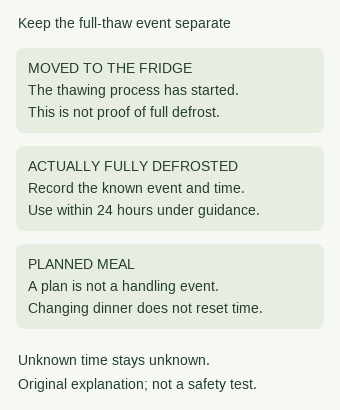
Write times only when you know what they represent. “Moved to fridge” starts a thawing arrangement; it does not establish that the middle of the portion is fully thawed. “Dinner at seven” is an intention, not an observation about the food.
On a phone, swipe inside this table. Keyboard users can focus the table region and use the arrow keys.
| Field | Useful actual fact | Mistake to avoid |
|---|---|---|
| Cooked and cooled/stored | Record the actual preparation and storage events relevant to the portion. | A future meal date cannot replace the handling history. |
| Frozen | Record when this identifiable portion went into the freezer, following its applicable instructions. | Freezing does not certify earlier cooling or reset every previous problem. |
| Moved to defrost | Record the actual transfer and defrosting method. | Starting thawing is not the same event as full defrost. |
| Fully defrosted | Record the known full-defrost event and time; leave it unknown if not established. | A guess based on a planned dinner cannot create a verified start time. |
| Planned use | Record the intended meal separately and update the plan when it changes. | Moving dinner later does not restart the source’s full-defrost clock. |
You may record a date only if that is all you know, but do not use a date-only entry to pretend that an exact hourly deadline is known. If several portions thaw at different rates, avoid copying the same observation to every portion without a basis.
Keep leftovers and full-defrost limits in their own contexts
The FSA document gives two different instructions: eat refrigerated leftovers within 48 hours or freeze them if that will not be possible; and use food within 24 hours after it has been fully defrosted. They describe different stages. Do not add them together to create a general “72 hours after thawing” rule.
For cooling cooked food, the source advises cooling at room temperature and putting it in the fridge within one to two hours, using smaller portions to cool quickly. Its advice to eat leftovers cold also depends on proper cooking, cooling and refrigeration within two hours. A label helps preserve these facts; it cannot make missing handling suitable after the event.
For defrosting, the source advises the fridge, a container large enough to catch drips, complete thawing including the middle, and sufficient time for the actual food. If fridge defrosting is not possible, it describes microwave defrosting directly before cooking. Follow the actual package guidance. This article gives no fixed number of hours that every portion will need to thaw.
Retain any stricter relevant instruction. The 24-hour calculation below explains one statement in the cited guidance. It is not a universal replacement for food-specific preparation, storage or use instructions.
Read a fictional label and check two 24-hour calculations
This is an invented record for explaining fields and arithmetic. Assume all applicable cooking, cooling, freezer, fridge and product instructions have been satisfied, and that the full-defrost event is known. The example is not an observed food test or a guarantee about an actual meal.
Portion: hypothetical vegetable dish, batch A, portion 1
Cooked: Tuesday 10 November 2026, 18:00
Put in fridge after cooling: Tuesday 10 November, 19:00
Frozen after cooling: Tuesday 10 November, 19:15
Moved to fridge to defrost: Wednesday 11 November, 18:00
Known full-defrost event: Thursday 12 November, 07:30
24-hour interval ends: Friday 13 November, 07:30
Planned meal: Thursday 12 November, 12:30
Relevant actual food instructions: kept separately with batch
The first calculation is Thursday 12 November at 07:30 plus 24 hours, which gives Friday 13 November at 07:30. The example does not infer that every dish moved to a fridge at 18:00 will finish thawing at 07:30. The hypothetical full-defrost fact is supplied separately.
In a second fictional example, known full defrost occurs on Friday 13 November 2026 at 23:15. Adding 24 hours gives Saturday 14 November at 23:15. It is not Friday midnight, and it is not 24 hours after a planned Saturday lunch. Both examples use the same local clock with no clock change during the interval.
Plan use within the relevant interval and other applicable instructions. Arithmetic checks a stated time; it does not assess temperature control, contamination, cooking requirements or the accuracy of someone else’s observation.
Handle missing times and changed meals explicitly
If a thawed portion has no known full-defrost time, write that uncertainty plainly. Do not substitute the freezer date, the time you noticed it, or a new planned meal time as if it were the missing event. Resolve the handling question using suitable actual instructions and food-safety guidance.
If dinner is cancelled, change the planned-use field while retaining the original actual events. Freezing or reheating is not a general way to erase uncertain history. The cited document says food can be frozen again once cooked, with only one reheating after that; keep that instruction with its actual cooking and handling context rather than turn it into blanket permission to refreeze any thawed food.
Case 1
The portion moved into the fridge on Wednesday evening. Does that prove the 24-hour full-defrost interval started then?
Show answer and explanation for case 1
No. Moving it starts an arrangement for thawing, not proof of full defrost.
Keep both event fields. The source’s 24-hour instruction is stated for food after it has been fully defrosted.
Case 2
A known full-defrost time is Thursday at 07:30, but Friday’s meal moved to 19:00. Does the deadline move too?
Show answer and explanation for case 2
No. Changing a planned meal does not change the actual full-defrost event.
Under the given 24-hour calculation, the interval ends Friday at 07:30. The changed plan must be checked against that and the other applicable instructions.
Case 3
The label only says “thawed Thursday”. Can I choose Thursday at 23:59 to make an exact deadline?
Show answer and explanation for case 3
No. That creates an unsupported time.
A date-only entry lacks the hourly fact needed for an exact calculation. Keep the uncertainty visible and obtain guidance for the actual handling situation.
Copy a short lifecycle label that fits your portion
Use only fields that help preserve relevant facts. Leave a field unknown rather than supply a fabricated time.
Food / batch / individual portion:
Relevant product or recipe instructions:
Actual cooked time, if relevant:
Actual cooling and chilled-storage facts:
Actual frozen date/time:
Actual moved-to-defrost date/time and method:
Known full-defrost event/date/time, or UNKNOWN:
Applicable use instruction and its basis:
Calculated interval, if the start is actually known:
Planned meal, kept separate:
Changed plan or unresolved handling question:
When portions move between people, pass the instructions and known events with them. A receiver should not have to infer whether “Thursday” means cooked, frozen, thawed or intended for lunch.
The broader freezer meal-prep guide helps assign a portion a meal role. Use the freezer-burn comparison for the separate appearance-versus-handling question. Neither a complete label nor an attractive meal plan proves an individual dish’s safety or weight-loss effect.
Sources and further reading
- Food Standards Agency on GOV.UK: How to chill, freeze and defrost food safelyComplete public guidance, published 18 December 2017; applies to England, Northern Ireland and Wales; consulted 10 November 2026. Used for the named chilling, cooling, leftovers, freezing, full-defrost, packaging and freezer-burn statements. It is not a new expert review or a tested transport arrangement.