Practical guide
Freezer Burn and Food Safety: Check Quality and Handling Separately
Freezer burn affects quality, while food handling still needs its own evidence. Compare packaging, known storage and full-defrost facts without using appearance to approve an individual portion.
Freezer burn is a quality issue, not a handling history
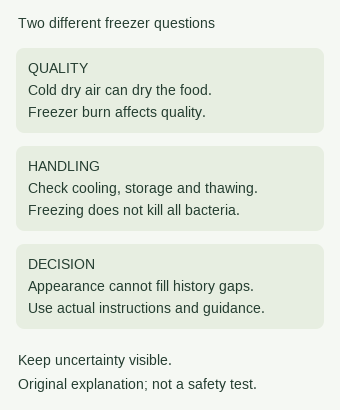
The FSA describes freezer burn as exposure to cold, dry freezer air, which dehydrates food and forms ice crystals over time. It says this process affects quality rather than safety. That answers what freezer burn itself does; it does not establish whether every other part of a particular food’s handling was suitable.
Ask two questions separately: what happened to the food’s quality while frozen, and what is known about its cooking, cooling, storage and thawing? A single answer such as “it looks frosty” cannot supply the missing history.
This distinction matters when you are planning meals from stored portions. You may be deciding whether a portion will be enjoyable to use, while also needing to resolve whether its actual storage and preparation instructions were met. Keep those decisions visible instead of turning a quality observation into a safety approval.
The handling guidance here comes from the Food Standards Agency document on GOV.UK, published 18 December 2017 and applying to England, Northern Ireland and Wales. We consulted its complete public text on 10 November 2026. Follow the actual food’s instructions and guidance for your location; this article does not establish an individual food’s safety or a personal weight-loss diet.
Freezing pauses growth; it does not erase earlier handling
The cited guidance explains that freezer temperatures around −18°C put bacteria on pause. The bacteria have not all been killed and can be revived as food defrosts. Cold also does not stop every kind of bacterial growth altogether.
“It was frozen” therefore is not a complete answer to a question about earlier cooling, an uncertain power interruption or how thawed food was held. A frozen appearance is an observation at one moment; it is not a temperature log for the whole storage period.
The source advises fridge defrosting, complete thawing including the middle, catching drips, and using food within 24 hours after full defrost. It also directs readers to follow actual packaging instructions. These handling questions remain relevant whether or not freezer burn is visible.
Do not taste a questionable food to try to fill a history gap. This article provides no visual, smell or taste test that can establish all relevant handling facts. If the food’s history is uncertain, use appropriate guidance for that actual situation rather than an appearance-only rule.
Compare quality observations with handling evidence
Keep an observation in the category it actually supports. The table does not inspect an individual food or make a keep/discard decision for it.
On a phone, swipe inside this table. Keyboard users can focus the table region and use the arrow keys.
| Question or observation | What it can help explain | What still needs separate checking |
|---|---|---|
| Cold-air drying or ice crystals described as freezer burn | The FSA’s freezer-burn explanation concerns food quality. | Cooking, cooling, temperature history, actual instructions and thawing remain separate. |
| Suitable packaging | Air-tight containers or well-wrapped freezer bags/wrap help protect against drying. | Packaging alone does not establish correct earlier handling. |
| A frozen portion with no known handling record | You know its present identification or appearance only to the extent actually observed. | Do not invent cooling or thawing times; resolve unknown handling through appropriate guidance. |
| A known full-defrost event | It provides the stated start for the relevant 24-hour instruction in the cited source. | Other food-specific storage, preparation and use instructions still apply. |
| A storage period used to plan quality | The source offers quality-oriented storage suggestions alongside its freezer-burn explanation. | A quality preference is not a universal safety expiry date or a guarantee of suitable handling. |
A calendar entry can help you use identifiable older portions before they become less appealing. It cannot convert an unknown storage condition into a verified one. Similarly, replacing poor packaging can improve a future routine but does not reconstruct the history of food already stored.
Protect quality with packaging and a usable identity
The FSA’s practical advice for limiting freezer burn is to use an air-tight container, wrap food well in freezer bags or freezer wrap, and label it. Use packaging suitable for the actual food and freezing purpose, with relevant manufacturer instructions.
Before freezing homemade portions, follow the food’s cooling and freezing guidance. The cited source advises cooling warm dishes, dividing food into smaller portions to cool quickly, and freezing leftovers and homemade goods as soon as possible. Packaging is part of the process, not a replacement for those steps.
Label enough to identify the portion and the relevant instructions. A portion named “vegetable dish, batch A” can be connected to its record; a container named only “lunch” may be difficult to distinguish from several different batches.
For a useful rotation, note the identity and actual freezing date, then plan use around the food’s instructions, quality preferences and your schedule. This guide gives no universal maximum freezer duration. The cited document’s storage suggestions in its freezer-burn discussion should not be treated as safety deadlines for every food.
If a freezer fault or an interruption creates an actual temperature-history question, that needs guidance for the situation. A rule intended to protect texture in normal freezer storage cannot answer that separate question.
Work through three fictional quality and history checks
These are hypothetical reading examples, not reports of tested foods or instructions to eat an individual portion.
Case 1
A fictional portion has cold-air drying described as freezer burn. Its earlier cooling time is unknown. Does “freezer burn affects quality” answer both questions?
Show answer and explanation for case 1
No. It answers the freezer-burn quality question only.
Unknown earlier cooling is a different handling fact. Do not fill it in from the portion’s appearance or the general quality explanation.
Case 2
A hypothetical meal has no visible freezer burn. Does that prove the freezer stayed at a suitable temperature throughout storage?
Show answer and explanation for case 2
No. A visual observation is not a full temperature history.
Check actual storage information and relevant guidance. The absence of a quality sign cannot supply evidence for an unobserved interval.
Case 3
A fictional label says full defrost occurred Monday at 10:00. The next meal is planned for Wednesday. Can good packaging extend the cited 24-hour interval to Wednesday?
Show answer and explanation for case 3
No. Packaging for quality does not change that full-defrost instruction.
Under the stated same-clock calculation, 24 hours ends Tuesday at 10:00. The actual food’s other instructions and history must also be satisfied; this is not a safety guarantee.
Keep an optional quality-and-history note
Use a brief note when it helps you distinguish why a portion needs attention. You do not need a score or a lengthy diary.
Food and portion identity:
Actual freezing date, if known:
Packaging used and relevant instructions:
Quality observation, described without a safety conclusion:
Known cooking/cooling/storage facts:
Defrosting method and known full-defrost time:
Food-specific preparation/use instructions:
Unknown handling facts:
Relevant guidance or information still needed:
Future packaging or rotation change:
A future improvement might be a clearer label, smaller individually identified portions or suitable packaging. Keep that improvement separate from the present portion’s unresolved facts. “I will label better next time” does not establish what happened this time.
Use the lifecycle label guide for actual-event fields and full-defrost arithmetic. If the next decision is carrying the meal to work, use the no-cook versus no-fridge check. Return to the freezer meal-planning page for the broader role of each portion after its actual handling questions are resolved.
Sources and further reading
- Food Standards Agency on GOV.UK: How to chill, freeze and defrost food safelyComplete public guidance, published 18 December 2017; applies to England, Northern Ireland and Wales; consulted 10 November 2026. Used for the named chilling, cooling, leftovers, freezing, full-defrost, packaging and freezer-burn statements. It is not a new expert review or a tested transport arrangement.