Practical guide
No-Cook or No-Fridge Lunch? Check Storage Before You Pack
A lunch eaten cold can still need refrigeration. Check the actual food’s unopened, opened, prepared or cooked state, then match its instructions to storage you can confirm before packing.
Separate cooking, reheating and storage questions
A no-cook lunch avoids a cooking step. A no-fridge lunch needs foods and arrangements that meet their storage instructions without an available fridge. Those are different questions. A food you can eat cold may still need chilled storage before you eat it.
Start with the actual food and its current state. An unopened package, its opened contents, a prepared salad and a cooked leftover do not automatically share the same storage instructions. A meal title such as “cold lunch” tells you very little about those requirements.
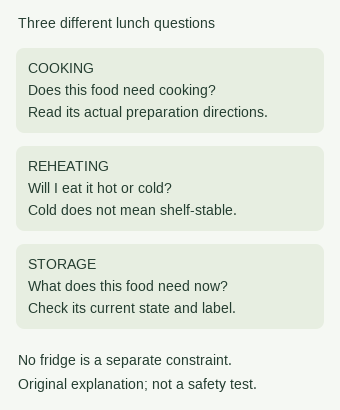
Ask three practical questions before packing: does anything need cooking; will anything need reheating; and how will each item be stored until it is used? A workplace microwave answers only the reheating question. A desk drawer answers none of the temperature questions by itself.
The handling guidance here comes from the Food Standards Agency document on GOV.UK, published 18 December 2017 and applying to England, Northern Ireland and Wales. We consulted its complete public text on 10 November 2026. Follow the actual food’s instructions and guidance for your location; this article does not establish an individual food’s safety or a personal weight-loss diet.
Read both the unopened and opened instructions
Read the complete storage wording on the actual package, including any instruction that applies after opening. If it is not clear, resolve it with suitable product information before making the package part of an arrangement that cannot meet the instruction.
“Store in a cool, dry place” on an unopened item is not evidence that its opened leftovers can sit in a lunch bag. The FSA guidance specifically reminds readers that some foods need the fridge once opened. It also advises transferring unused contents of an opened tin into a storage container, covering and refrigerating them.
For a hypothetical package that says “refrigerate after opening”, write two different facts: what is required before opening, and what will be required once it is opened. Do not replace either with the shortcut “this is a pantry food”. This example does not describe a real brand or approve a particular product.
Check whether you will open the whole item at mealtime, prepare it earlier, or keep a remainder for another day. Each change can create a different storage problem. Buying a larger pack to save money can be unhelpful when you have no arrangement for its opened remainder.
Compare the food state with the available storage
The FSA document says to refrigerate foods with a use-by date, cooked dishes, salads and dairy products, and to follow package storage instructions. Its fridge range is 0–5°C. Use the actual instruction for each item rather than infer a storage category from whether it is cooked.
On a phone, swipe inside this table. Keyboard users can focus the table region and use the arrow keys.
| Food state | What to establish | What this does not prove |
|---|---|---|
| Unopened package | Read storage and preparation instructions for that exact unopened item. | Being unopened does not automatically mean it needs no fridge. |
| Opened package or unused tin contents | Read after-opening directions; transfer unused tin contents into a covered container and refrigerate as the source advises. | An unopened storage instruction does not cover an opened remainder. |
| Prepared food such as a salad | Check the actual ingredients, preparation directions and required chilled arrangement. | Avoiding cooking does not remove chilled-storage needs. |
| Cooked leftover intended to be eaten cold | The source permits cold leftovers when properly cooked, cooled and refrigerated within two hours; use its relevant leftover guidance. | A cold serving temperature does not prove correct earlier handling or suitable transport. |
For cooked food, the cited guidance says to cool at room temperature and put it in the fridge within one to two hours; divide it into smaller portions to cool quickly. It says to eat refrigerated leftovers within 48 hours or freeze them if that will not be possible. These statements do not supply a time allowance for carrying food in an unverified work bag.
This guide supplies no ice-pack count, commute duration or room-temperature transport guarantee. A claim that a bag “keeps things cold” needs appropriate instructions and evidence for the actual arrangement. If storage is unconfirmed, keep it unconfirmed in the plan.
Apply the distinction to three hypothetical lunches
These are fictional reading examples. They illustrate which fact is missing, rather than declare any meal safe.
Case 1
A hypothetical pack requires refrigeration. I will eat it without cooking. Can I treat it as a no-fridge lunch?
Show answer and explanation for case 1
No. Its cooking and storage requirements are separate.
The absence of cooking leaves its refrigeration requirement in place. Arrange appropriate storage or choose an option whose actual instructions fit the available conditions.
Case 2
An imaginary unopened item has one storage instruction and says to refrigerate after opening. Does the first instruction cover tomorrow’s opened leftovers?
Show answer and explanation for case 2
No. Check and meet the after-opening instruction for the remainder.
The example deliberately changes the food state. Keeping the unopened wording on a plan does not establish suitable storage once the item is opened.
Case 3
I correctly cooled a cooked portion and put it in the fridge. The office has a microwave but its fridge is unconfirmed. Does the microwave complete the plan?
Show answer and explanation for case 3
No. Storage before reheating remains unresolved.
A heating facility does not document the portion’s storage during travel or the workday. Check the complete arrangement instead of using reheating as evidence for an unknown interval.
Choose an alternative that fits confirmed conditions
List the conditions you actually have: a fridge you are allowed to use, an appropriate verified chilled arrangement, somewhere to buy food at the relevant time, or storage that suits the specific unopened items you plan to bring. An expected facility is not a confirmed one.
If the original meal depends on an unavailable condition, change the meal arrangement before packing. That may mean choosing different actual items, preparing at a different time, obtaining a suitable storage arrangement, or buying a meal when you need it. Check that the chosen alternative itself meets its instructions; a generic list of “no-fridge foods” cannot do that job for every product.
Keep the meal useful to you as well as practical. Food preferences, allergies, dietary needs, availability and cost still matter. This storage check does not tell you that two alternatives contain the same nutrients or calories. Use the busy-week nutrition guide for a broader meal framework and the schedule comparison to distinguish available facilities from assumptions.
Keep a short optional storage check record
A small record helps when lunch plans change. You do not need to log every meal; record enough to identify a condition that still needs resolving.
Item and portion:
State when packed: unopened / opened / prepared / cooked
Actual storage instruction before use:
Instruction after opening, if relevant:
Preparation required:
Confirmed storage until mealtime:
Facts still unknown:
Workable alternative checked against its own instructions:
Remainder and its storage plan:
Write “unknown” if you have not confirmed a fridge, handling event or instruction. Do not fill a blank with an optimistic assumption merely to make a menu look complete. The record supports planning; it is not a food-safety certificate.
For a frozen portion, use the freezer-label guide to keep cooking, freezing and full-defrost events separate. For a menu you will eat without cooking, return to the broader no-cook meal plan after checking storage. The next useful decision is the one that closes your actual lunch constraint.
Sources and further reading
- Food Standards Agency on GOV.UK: How to chill, freeze and defrost food safelyComplete public guidance, published 18 December 2017; applies to England, Northern Ireland and Wales; consulted 10 November 2026. Used for the named chilling, cooling, leftovers, freezing, full-defrost, packaging and freezer-burn statements. It is not a new expert review or a tested transport arrangement.