Beginner Gym Plan for Weight Loss: Prepare Your First Visits
Revised · General planning information
A useful beginner gym plan starts with a visit you understand and can repeat: check access, learn the equipment, use activities appropriate to you and finish with a clear next step. Keep exercise choices separate from calorie compensation and promises about weight loss.
What should a beginner's gym plan include?
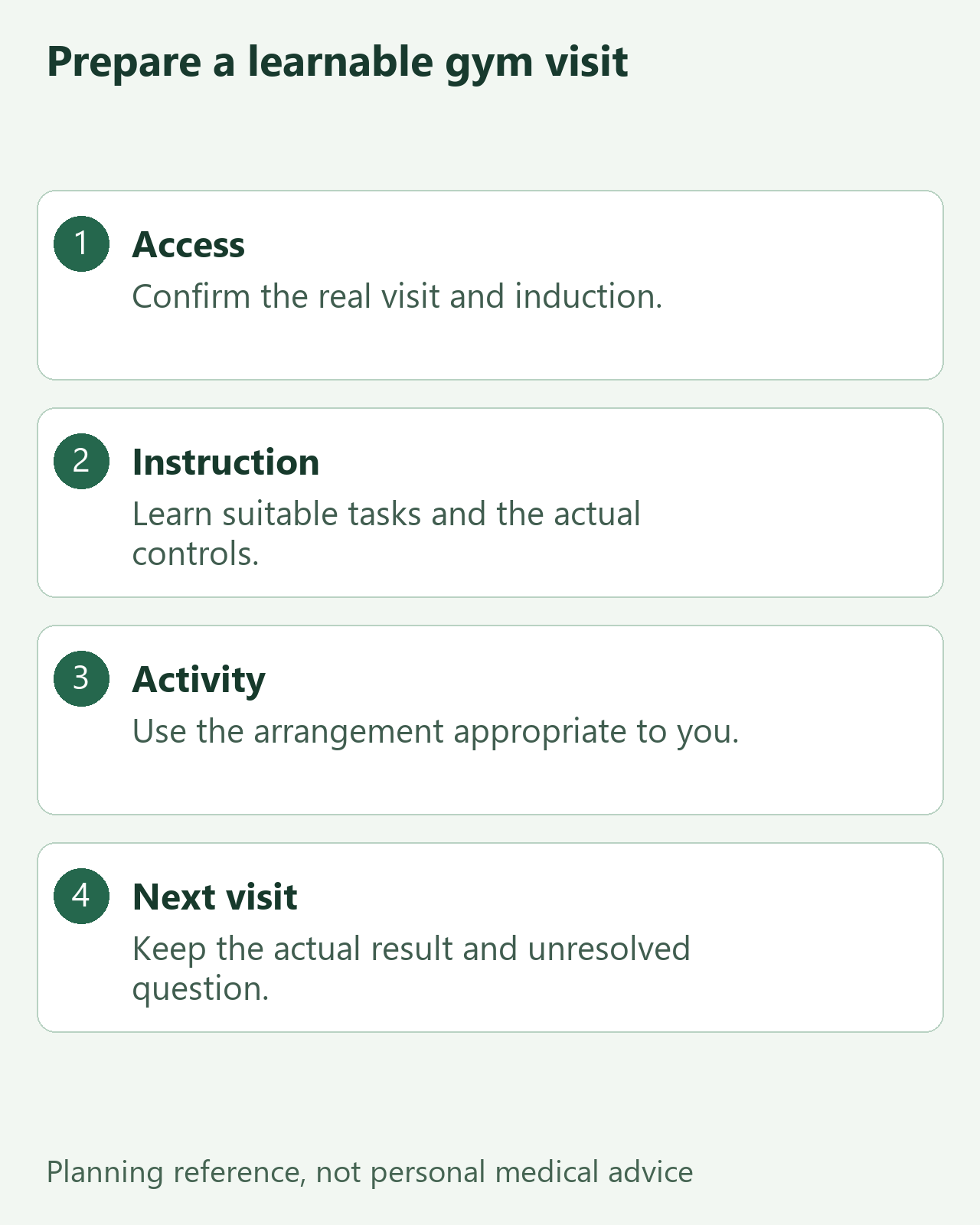
Use a simple visit structure: check in and learn the setting, prepare for your chosen activity, use an appropriate aerobic option, learn suitable strength movements, then finish and record what you need for the next visit. The specific activities and amounts should fit your ability, health, instructions and available time. This article supplies a planning sequence, not a universal set-and-repetition prescription.
For a first visit, understanding the setup is a useful outcome. You do not need to try every machine or leave exhausted. A gym plan that depends on equipment you cannot operate, a class you cannot access or an unrealistic journey needs a practical change before it needs more effort.
Physical activity can support weight management, but the gym does not guarantee a particular result. NIDDK notes that activity has important health benefits independent of weight loss and that its amount and type depend on personal health and ability. Keep food and treatment decisions under the appropriate guidance rather than using a machine's calorie estimate to choose what you are allowed to eat.
Check what the first visit actually requires
Before going, confirm opening hours, check-in arrangements, any induction requirement and whether the intended area or class needs booking. If you need an accessible entrance, usable changing space or support, ask about the actual features rather than relying on a general “beginner friendly” label.
Put the full visit on your calendar. Include travel, changing, finding equipment, learning the controls and returning to your next commitment. The first visit may contain more orientation than later visits. A free hour in the calendar is not automatically an hour of exercise.
Bring the items required by the venue and what you need for your circumstances. Check clothing, footwear, lockers and any relevant personal instructions in advance. You can leave optional purchases until you know what the setting requires; a long equipment shopping list does not make the visit more suitable.
If you have not exercised for some time or have medical conditions or concerns, NHS guidance says to speak to a GP first and make activity and intensity appropriate for your fitness. A staff induction teaches equipment operation; it does not replace that health advice or adapt a clinical rehabilitation plan.
Learn the equipment before choosing an amount
Ask a qualified member of staff to show the equipment you intend to use. Learn the adjustment points, how to start and stop, how to enter and leave safely, and the instructions for the actual model. Another machine with a similar name may have different settings or controls.
For a treadmill or other powered equipment, understand the stop control and venue instructions before beginning. For resistance equipment, understand the seat, supports, load selection and movement instructions. Do not copy another person's settings or assume that the number on a selector is your starting load.
Ask for the explanation in a form you can use. You can request a demonstration, repeat the instructions back, or note the machine identifier and the settings you were shown. If something is unclear, resolve it before using the equipment rather than treating the first session as trial and error.
Learning an appropriate movement matters more than collecting several unfamiliar ones. The staff member should help you choose suitable tasks and explain their amount, control and progression. This page cannot inspect your technique or choose a safe resistance through a description of your goal.
Use this first-visit sequence
Write the sequence in ordinary words. The phases below show what each part is for and what you need to know. Their order may change under your own program or venue instructions. They are not a timed circuit to complete regardless of how the visit goes.
On a narrow screen, scroll the table sideways to read all columns.
| Part of the visit | Practical task | What to put on your card |
|---|---|---|
| Arrival and induction | Check the venue, access, equipment instructions and help arrangements | The area you can use and whom to ask |
| Preparation | Follow preparation appropriate to the activity and your instructions | What you were advised to do before the main task |
| Aerobic option | Use a familiar, suitable option, such as walking or cycling when appropriate | The equipment or task, controls and instructed effort or amount |
| Strength learning | Learn suitable movements with instruction rather than sampling every machine | Movement version, equipment, settings and amount explained to you |
| Finish | Follow the finishing instructions and leave time to exit without rushing | Anything to check before leaving and questions for the next visit |
| After-visit note | Keep the actual tasks and practical experience beside the plan | What happened, what was unclear and what still fits next time |
You can complete the orientation task without completing every activity phase. If instruction is unavailable, the visit can end with an induction appointment or a clear question. Leaving an unfamiliar task out is more useful than pretending a list from the internet supplied the missing instruction.
Choose aerobic and strength tasks for different purposes
Aerobic activity and muscle-strengthening activity are related parts of an activity pattern, but they are different tasks. A clock running during a strength session does not establish that all of its minutes are moderate aerobic activity. Likewise, walking on a treadmill does not automatically cover all major muscle groups with strengthening work.
NHS guidance for adults aged nineteen to sixty-four includes aerobic activity alongside strengthening work for the major muscle groups. It describes moderate effort as breathing faster while being able to talk but not sing. That is general intensity context, not a medical screening test or a requirement to reach that effort during your first visit.
For the aerobic part, choose an appropriate option whose operation you understand. Familiar walking or cycling may fit some people; another activity or support arrangement may fit others. A device's default program, speed or resistance does not know your circumstances.
For strength learning, think in terms of suitable movements and clear instruction rather than a ranking of machines. A staff-guided selection may include a supported pushing task, a supported pulling task and an appropriate lower-body task. The particular equipment, movement version and amount need to be chosen for you. You do not have to add all categories on the same first visit.
When a plan already specifies exercises, use its names, versions and instructions. Ask its provider about equipment substitutions. Similar-looking movements are not automatically interchangeable, especially when equipment, assistance or a care instruction differs.
Keep a short card that can guide the next visit
After instruction, record the practical details that would otherwise be easy to forget: the machine identifier, adjustment settings, movement version, amount explained to you and any important control or rest instructions. Distinguish the advice you received from the activity you actually did.
A card might say: “Station identifier: recorded from the venue; settings and movement: as demonstrated; actual task: recorded afterwards; unresolved question: ask staff before repeating.” Fill it with your own reliable information. An empty field is a question, not a reason to borrow another person's load or repetitions.
If you prefer a shorter note, keep the activity names, actual result and the question that needs answering. You do not need a complete dashboard. The existing training-volume resource explains quantities and calculations if that later becomes useful; it is not a prerequisite for a first visit.
Do not make a larger recorded number the main goal of returning. More load, a faster device setting or a longer visit may reflect a changed task and may not be appropriate. Ask for suitable progression instructions when you need them.
Plan for busy equipment and changing access
If a chosen station is occupied, follow a suitable alternative already explained to you, wait if that fits, or leave that task for another visit. An unoccupied machine is not automatically an equivalent substitute. Confirm the movement and settings before adding unfamiliar equipment.
Keep preparation and finishing time intact when the venue is busy. If the real window shrinks, revise the activity arrangement using appropriate instructions rather than rushing through equipment operation. A schedule problem does not justify faster repetitions, more intensity or skipping a necessary check.
If access problems repeat, review the time, booking, location or instruction arrangement. A different quiet period may help, but confirm it instead of assuming every early or late visit is accessible. Cost, transport and support availability can also determine whether the gym is a practical setting.
A gym is one possible place for activity. NIDDK's program questions ask whether a gym or structured program is required and whether activity can happen in different locations. An appropriate familiar alternative may fit better than repeatedly forcing an unavailable venue into the week.
Give symptoms a help response, not a performance target
Stop activity for concerning pain, dizziness, feeling faint, chest discomfort or other worrying symptoms and seek appropriate help. Do not use a smaller setting to test whether the concern has gone away, and do not continue to finish the card.
NHS emergency examples include fainting while exercising and sudden chest pain or discomfort that does not go away, pain spreading to an arm, neck, jaw, stomach or back, or chest pain with sweating, feeling sick, lightheadedness or breathlessness. Use local emergency help when needed and follow its instructions. These examples do not cover every possible emergency.
Ask venue staff for help with the immediate setting, but keep medical assessment separate from equipment instruction. A symptom-free moment or a shorter workout does not establish readiness to restart. Follow relevant professional advice.
Review the first visit before scheduling more
Write what made the visit usable: clear instruction, an accessible area, a workable journey or an activity you understood. Also record the specific difficulty. “The induction was not booked” calls for a different change from “the return journey used the evening window.”
Check the next actual opportunity and keep the suitable parts that still fit. The next visit can repeat a learnable arrangement while an unresolved question is answered. You do not need to increase several variables at once or restore an imagined exercise debt from a missed week.
For example, a fictional beginner reserves time for arrival, staff instruction and one appropriate familiar activity. The intended strength task remains unconfirmed because an induction appointment is needed. Their next plan is to obtain that instruction, not to add an unfamiliar machine. The example shows a planning decision rather than a recommended exercise dose.
If food compensation, fear of missing a session or distress around numbers is becoming part of the plan, seek suitable support. Exercise is not a punishment for eating. The practical record should make a visit easier to understand, not create pressure to earn meals or override care instructions.
Examples to work through
These fictional examples illustrate choices in everyday settings.
A free machine has unfamiliar controls
Rosa arrives when the machine she expected to use is occupied. Another machine looks similar, but she has not learned its controls or movement. She asks staff for suitable instruction or uses a familiar appropriate option already explained to her. An open station solves availability only; it does not automatically solve exercise selection or setup.
The visit window includes a long journey
Ben writes a gym session into a gap between work and another commitment. He then includes the actual return journey, changing and induction time. The proposed activity block no longer fits. He chooses another real opportunity or an appropriate familiar arrangement with less travel, rather than rushing equipment checks to defend the original calendar entry.
The note records attendance but not instructions
Aisha knows she attended her first visit and used a staff-demonstrated task, but she cannot recall an important setting. She keeps attendance as a known fact and writes the setting as a question. Before repeating the task, she asks for confirmation. A forgotten setting is not recovered by copying a number from a nearby person's equipment.
A symptom interrupts the plan
Noah feels faint during activity and wants to finish the last planned task. He stops and seeks appropriate help. The unfinished item remains unfinished; a completion target does not resolve the concern. He does not use a gentler setting as a return test or treat being able to leave the machine as medical clearance.
Beginner gym visit and instruction record
Use this optional text record for practical checks, choices and questions needing advice. Keep notes in an appropriate private place. Downloading it does not send your completed notes to this site or assess health. Do not delay necessary help to fill in a record.
Frequently asked questions
Should my first gym visit be a full-body workout?
It can begin with learning the setting and suitable tasks. A full list is useful only when the activities and instructions fit you. Ask for appropriate exercise selection and equipment teaching. This page does not require every muscle group or every activity phase on the first visit.
How many sets, repetitions or minutes should I use?
Use an amount appropriate to your activity, ability and instructions. A general article cannot choose your machine load or inspect technique. Ask the relevant qualified person for a usable starting arrangement and progression guidance; do not copy another member's settings or a device's default program.
What if the gym is too busy to follow the plan?
Use a suitable alternative you already understand, wait if it fits or revise the visit. Do not substitute unfamiliar equipment solely because it is free. Repeated access problems may need a different booking, time or location, with preparation and finishing time preserved.
Will gym workouts make me lose weight quickly?
This guide cannot predict an individual result or timeline. Activity has benefits independent of weight loss and may be part of supported weight management. Keep eating and treatment decisions under appropriate guidance. A calorie display is not a rule for food compensation.
Choose the next reading task
Sources and what they support
- NHS: Physical activity guidelines for adults aged 19 to 64
General adult activity context and seeking GP advice when starting after inactivity or where medical concerns apply. Population recommendations do not choose an individual first-visit routine or supply medical clearance.
- NIDDK: Choosing a safe and successful weight-loss program
Program goals, evidence, staff, support, costs, lifestyle and cultural fit, individual health context and maintenance. General program guidance does not supply a personal calorie target or guarantee a weight result.
- NHS: Fainting
Assessment and emergency examples, including fainting during exercise. A symptom-free interval does not establish readiness to restart. Use the appropriate local service; NHS service pathways are UK-specific.
- NHS: Chest pain
Concerning chest-pain examples and getting appropriate help rather than self-diagnosing. The captured page reports an August 2023 review and a review due in August 2026; capture in November is not evidence of a new source update. NHS service pathways are UK-specific.
- NHS: Eating disorders overview
Concerns involving food, weight and shape, strict routines and excessive exercise, and getting appropriate support. A tracker cannot diagnose or rule out a disorder from body size or entries.
General planning information based on the listed sources. Individual health and nutrition advice may be needed. The fictional examples, diagrams and optional records are original aids, not diagnoses, clinical assessments or tested weight-loss plans. No clinical reviewer is claimed for this article.